
← All blog articles · Play & Learning topic hub
Quick answer: Is it good for kids to be bored? Occasional boredom is normal and probably useful: researchers describe it as a signal that pushes a person to look for something more engaging. But the popular claim that boredom makes children creative rests mostly on small studies of adults, and boredom at school is linked with poorer outcomes in older students. The evidence can tell you that you don't have to fix every bored moment; it can't tell you that boredom itself is good for a child.
Key takeaways
- Researchers treat boredom as a signal: attention isn't engaged, or the activity doesn't feel worth doing.
- The boredom-and-creativity experiments most often quoted were done with adults. In one study of ninth graders, bored moments were on average less creative, not more.
- In one study of 130 children aged 4 to 6, parents reported that most coped with boredom by asking someone to play or by finding something to do.
- Being bored now and then is different from boredom that keeps showing up at school, which goes with poorer school outcomes in large studies.
- A parent's job is less to entertain and more to leave room, and sometimes to play.
What is boredom, according to researchers?
Boredom is not the same as having nothing to do. In a 2012 paper in Perspectives on Psychological Science, John Eastwood and colleagues summed up how theories describe it: “the aversive experience of wanting, but being unable, to engage in satisfying activity.” The child who says “I'm bored” in a room full of toys fits that description well: the problem is not a lack of options but that none of them is holding their attention.
Erin Westgate and Timothy Wilson's 2018 model, published in Psychological Review, names two ingredients. One is attention: the activity is too easy or too hard for the mental energy a person has available. The other is meaning: the activity doesn't connect to anything the person cares about. Either one alone can produce boredom.
Several theorists argue the feeling has a job. Shane Bench and Heather Lench (2013) proposed that boredom motivates people to switch to a new goal when the current one has stopped paying off. These are theory and review papers, not tests of what boredom does for children. They explain why boredom might be useful; they do not measure what it does for children.
Does boredom make kids more creative?
This is the claim parents hear most, and it traces largely to two experiments by Sandi Mann and Rebekah Cadman, published in Creativity Research Journal in 2014. In the first, 80 adults recruited through a community church were split into two groups. Half copied numbers out of a phone book for 15 minutes; the other half skipped that step. Everyone then had 3 minutes to list uses for a pair of polystyrene cups. The phone-book group listed more uses. Their best answers, however, were not rated as more creative than the other group's.
A second experiment with 90 adults added a version in which people only read the phone numbers. The boring tasks were again followed by more ideas on two idea-listing tasks, and this time the ideas were also rated as more creative than the control group's, the opposite of the first experiment. The authors call that contradiction a reason for larger replications. On a third, word-puzzle task only the reading group did better. The authors suggested daydreaming as the link. Two details limit how far this goes: only participants who rated the task as very boring and said they had daydreamed went on to the creative tasks, and nobody under 18 took part.
Later studies complicate the picture. Julia Haager, Christof Kuhbandner and Reinhard Pekrun (2018) looked at what happens when the creative task itself becomes boring. Across six rounds of an idea-generation task, boredom and the number of ideas both rose, but once the researchers accounted for practice, boredom was linked with fewer ideas, not more.
Two studies have looked at teenagers in school. Maike Krannich and colleagues (2025) studied 119 German eighth graders in math class. On the first of three tasks, boredom on its own was not related to creative answers. It went with more creative answers when students also felt under-challenged, and with fewer when they felt over-challenged, the latter on the first task only. Anke Zeißig and colleagues (published online in 2026) asked 111 ninth graders to report on moments throughout the school day. On average, moments that students did not find boring scored higher on creativity than bored moments. Among the bored moments, a calm, mildly pleasant kind of boredom scored highest and a strongly unpleasant kind scored lower.
The Mann and Cadman, Krannich and Zeißig studies involved no one younger than about 13, and the published summary of the Haager study does not say who took part. As far as we could find, no experiment has tested whether a bored young child goes on to play more creatively.
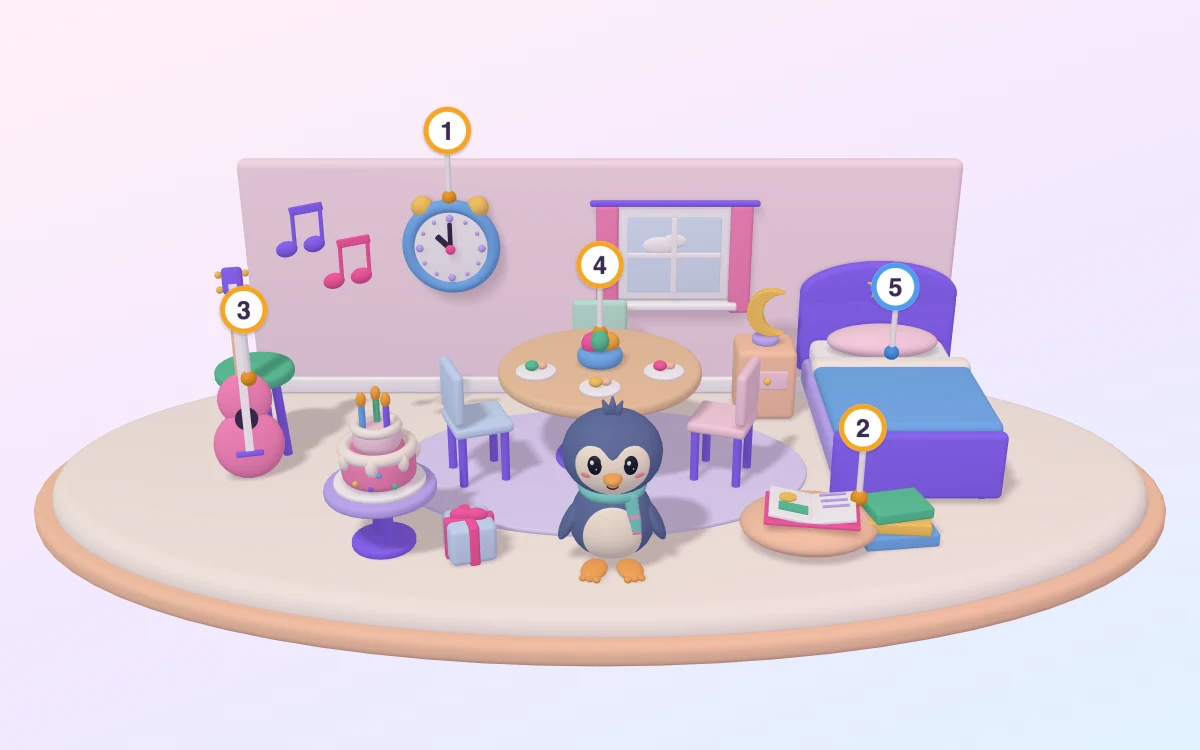
Five things studies say about boredom
Each pin marks one finding from this article, colored by how strong the evidence is. Most of it comes from adults and teenagers, not young children.
- Some evidence
- Limited evidence
1. Boredom is a signalEvidence: Theory and review papers (limited evidence)
Theorists describe boredom as a sign that attention isn't engaged or that the activity doesn't feel worth doing, and argue that it pushes people toward a new goal (Eastwood and colleagues, 2012; Bench and Lench, 2013; Westgate and Wilson, 2018). These are theory papers built mostly on research with adults.
2. A boring task, then more ideasEvidence: Small adult experiments (limited evidence)
In Mann and Cadman's first experiment (2014), 80 adults either copied phone numbers for 15 minutes or skipped that step. The phone-book group then listed more uses for a pair of cups, but their best answers were not rated as more creative; a second experiment found they were. Nobody under 18 took part.
3. Bored moments at school were less creativeEvidence: Mixed findings (limited evidence)
When 111 ninth graders reported on moments during school, the moments they did not find boring scored higher on creativity on average (Zeißig and colleagues, 2026). In another study, getting bored with a creative task itself went with fewer ideas once practice was accounted for (Haager and colleagues, 2018).
4. Young kids ask someone to playEvidence: One study of young children (limited evidence)
In a study of 130 children aged 4 to 6, most coped with boredom, by their parents' accounts, by asking to play with a parent or by finding something to do, such as playing with toys (Anderson and Perone, 2024). Children rated as more prone to boredom were also rated lower on self-regulation, a correlation.
5. Being bored often is a different thingEvidence: Large correlational studies (some evidence)
Across 29 studies of 19,052 students, more boredom in class and while studying went with lower motivation and achievement (Tze and colleagues, 2016). In US surveys of 106,784 teenagers, agreement with “I am often bored” rose from 2010 to 2017 (Weybright and colleagues, 2020). Both are correlational.
What do kids do when they are bored?
The most direct evidence on young children comes from Alana Anderson and Sammy Perone, working at Washington State University. In a 2024 study in the Journal of Experimental Child Psychology, they asked the parents of 130 children aged 4 to 6 how prone their children were to boredom and how the children coped with it. By the parents' accounts, most used what the authors call social strategies, such as asking to play with a parent, or behavioral strategies, such as playing with toys. Children rated as more prone to boredom also tended to be rated lower on self-regulation, the same pattern seen in adults. That is a correlation from parent reports in one mostly White, higher-income sample, so it cannot say which comes first.
That finding takes some pressure off. A young child who answers boredom with “play with me” is doing what most children in that study did. The American Academy of Pediatrics' 2018 clinical report on play, led by Michael Yogman, describes play with parents and peers as an opportunity to build social-emotional and self-regulation skills.
Time that children direct themselves does have some support of its own. We cover that research, and its limits, in what studies say about unstructured play.
When is boredom not a good sign?
Researchers separate boredom in the moment from being prone to boredom much of the time. Boredom that keeps showing up at school has a worse record. Virginia Tze and colleagues (2016) pooled 29 studies of 19,052 secondary and college students and found that more boredom in class and while studying went with lower motivation, weaker study habits and lower achievement, an average correlation of −0.24.
Elizabeth Weybright and colleagues (2020) analyzed yearly US surveys of 106,784 students in 8th, 10th and 12th grade from 2008 to 2017. Agreement with the single statement “I am often bored” was flat or slightly down until 2010 and then rose through 2017, earlier and more steeply for girls than for boys. The authors point out that boredom in adolescence is related to health risk behaviors, and that one survey question is a thin measure.
All of this is correlational. Frequent boredom may contribute to these problems, result from them, or share a cause with them, such as schoolwork pitched at the wrong level. And most of it comes from teenagers and college students, not young children.
This article is general information, not medical advice. If your child seems bored nearly all the time, has lost interest in things they used to enjoy, or you are worried about their mood or attention, talk with your pediatrician.
What the research does not show
- That boredom makes children creative. The supportive experiments are small, used adults, contradicted each other on whether the ideas were actually more creative, and measured ideas in the minutes after a dull task.
- That more boredom is better. Nothing here supports making a child bored on purpose or taking toys away to force creativity.
- That stepping in does harm. The closest study is small: among 83 children aged 4 to 6 (Perone and colleagues, 2026), those whose parents said they let them resolve boredom on their own showed a brain-activity pattern during a boring task that the researchers read as approaching it rather than avoiding it. That is a correlation in one sample; it does not show that helping a bored child causes harm.
- What screens do to boredom. The studies above did not test whether handing over a tablet at every “I'm bored” changes how children handle boredom later.
What the research does support is modest: boredom is an ordinary feeling with a plausible purpose, and young children usually respond to it by seeking company or something to do.
What to do when your child says they are bored
These steps follow from the studies above, but none has been tested as a method. The scripts are illustrative.
Try this at home
- Name it without fixing it. Example script: “Sounds like nothing feels fun right now. That happens.”
- Ask one open question, then wait. “What do you feel like making or doing?” Give it a few minutes before offering ideas.
- Write a bored list together on a calm day. Let your child choose what goes on it, in their words, and keep it where they can see it.
- Check the fit. If one activity always ends in “I'm bored,” adjust the level or the reason for doing it.
- Keep open-ended materials within reach. Paper, tape, blocks, a box. A small set can be enough; see what the fewer-toys study found.
- Say yes to playing sometimes. Asking you to play is a normal way for a young child to cope with boredom, not a failure to cope.
- Leave some time unscheduled. An after-school routine with a free block, or a summer day with a short list of chores and then open time, gives boredom somewhere to go.
More research summaries on how children play are in our play and learning hub.
A short list, then open time
Star Chart Kids is one optional tool for the have-to parts of the day. Parents set up Morning, After-School and Bedtime quests or custom ones, children check off each task, and a short list leaves the rest of the afternoon open. It doesn't fill free time and it won't cure boredom; it has no ads, loot boxes, chore leaderboards or streaks. It is free; a parent creates a username and parent passcode (no email or payment required), and it needs an internet connection to load. A paper list works too.
Frequently asked questions
Is it good for kids to be bored sometimes?
Occasional boredom is a normal feeling and, as far as researchers can tell, a useful signal that an activity is too easy, too hard or doesn't matter to the child. What seems to count is what happens next. No study we found has shown that boredom itself makes children more creative, and a few studies link frequent boredom at school with worse outcomes, so ordinary bored moments are fine but boredom is not something to schedule on purpose.
Does boredom make kids more creative?
Not that we could find. The best-known experiments, by Sandi Mann and Rebekah Cadman in 2014, found that adults listed more ideas after a boring task, but the two experiments disagreed on whether those ideas were rated as more creative. In one study of ninth graders, bored moments were on average less creative than other moments, and in another, boredom went with more creative math answers only when students felt under-challenged.
What should I do when my child says they are bored?
Acknowledge the feeling, ask one open question such as what they feel like making or doing, and then give them a little time before you step in. A list of ideas your child wrote on a calm day can help. Playing with you is also a fine answer some of the time: in one study of 4- to 6-year-olds, parents reported that asking a parent to play was among the most common ways children coped with boredom.
Do kids need to be entertained all the time?
No. The AAP's 2018 clinical report on play describes play with parents and peers as good for children, and no research we found says a parent has to fill every gap. Young children often want company when they are bored, which is normal, so a mix works: some time together, and some stretches where finding something to do is the child's job.
When is a child's boredom a concern?
Researchers separate passing boredom from being bored much of the time. In large studies of teenagers and students, more boredom at school goes together with poorer school outcomes, although those studies cannot show that boredom is the cause. If your child seems bored nearly all the time, has lost interest in things they used to enjoy, or you are worried about their mood or attention, talk with your pediatrician.
Sources and further reading
- The kids are bored: Trait boredom in early childhood and links to self-regulation, coping strategies, and parent-child interactions (Journal of Experimental Child Psychology (Anderson & Perone, 2024))
- How Parents Support Their Children's Boredom Relates to Dynamics of Neurophysiological Correlates of Self-Regulation (Infant and Child Development (Perone, Vaughan, Anderson & Weybright, 2026))
- Does Being Bored Make Us More Creative? (Creativity Research Journal (Mann & Cadman, 2014))
- To Be Bored or Not To Be Bored: How Task-Related Boredom Influences Creative Performance (The Journal of Creative Behavior (Haager, Kuhbandner & Pekrun, 2018))
- Investigating the Relationship Between Boredom and Creativity: The Role of Academic Challenge (Education Sciences (Krannich, Calik, Goetz, Ullrich & Lipnevich, 2025))
- Boredom and creativity in classrooms: A latent profile analysis (Learning and Instruction (Zeißig, Moeller, Minas, Goetz & Bilz, published online 2026))
- The Unengaged Mind: Defining Boredom in Terms of Attention (Perspectives on Psychological Science (Eastwood, Frischen, Fenske & Smilek, 2012))
- Boring thoughts and bored minds: The MAC model of boredom and cognitive engagement (Psychological Review (Westgate & Wilson, 2018))
- On the Function of Boredom (Behavioral Sciences (Bench & Lench, 2013))
- Evaluating the Relationship Between Boredom and Academic Outcomes: A Meta-Analysis (Educational Psychology Review (Tze, Daniels & Klassen, 2016))
- More Bored Today Than Yesterday? National Trends in Adolescent Boredom From 2008 to 2017 (Journal of Adolescent Health (Weybright, Schulenberg & Caldwell, 2020))
- The Power of Play: A Pediatric Role in Enhancing Development in Young Children (Pediatrics, American Academy of Pediatrics clinical report (Yogman, Garner, Hutchinson, Hirsh-Pasek & Golinkoff, 2018))
- Older and Wiser? Age-related Change in State and Trait Boredom During Adolescence and Associations with Neural Correlates of Self-regulation (Adaptive Human Behavior and Physiology (Perone, Anderson & Weybright, 2023))