
← All blog articles · Play & Learning topic hub
Quick answer: The benefits of unstructured play that research links most often are movement, better self-regulation and practice at steering one's own thinking without adult prompts, plus time with other kids and plain fun. The American Academy of Pediatrics (AAP) asks pediatricians to protect this time. What the evidence can't tell you is how much is cause and effect: nearly all of it is correlational, and no government guideline sets a number of free-play minutes.
Key takeaways
- Two AAP clinical reports (Ginsburg, 2007; Yogman and colleagues, 2018, reaffirmed 2025) have urged pediatricians to protect free playtime from hurried schedules and academic pressure.
- Studies link free play to better self-regulation and self-directed thinking, but they are correlational.
- Peter Gray's claim that lost free play helped drive rising anxiety and depression is a serious argument from trends and correlations, not a tested finding.
- No government guideline sets free-play minutes; the WHO and US figures are physical activity targets.
- Organized activities aren't the enemy; balance is the goal.
Structured vs unstructured play: what counts?
Unstructured play, often called free play, is play a child chooses and runs: what to do, how, with whom and when to stop. An adult may be nearby for safety but isn't setting the goal or the rules. Structured activities come with an adult-set plan: lessons, practices, tutoring, homework and coached sports.
| Usually unstructured | Usually structured |
|---|---|
| Building a fort out of couch cushions | A robotics class with a set project |
| A game of tag the neighborhood kids made up | Soccer practice with drills |
| Shooting hoops alone after practice ends | The practice itself |
What are the benefits of unstructured play?
Roughly from strongest evidence to weakest:
- Movement and motor skills. Active free play counts toward daily activity targets, and the 2018 AAP report ties play to foundational motor skills.
- Self-regulation. Toddlers and preschoolers with more unstructured quiet play had better self-regulation two years later (Colliver and colleagues, 2022).
- Self-directed thinking. In one small study, children with more less-structured time were better at steering their own thinking without prompts (Barker and colleagues, 2014).
- Mood and coping. Adventurous play had small links to fewer anxiety symptoms (Dodd and colleagues, 2022); bigger mental-health claims are argued, not settled.
- Social skills and fun. Negotiating rules and turns, and plain enjoyment; support here comes mostly from expert reviews like the AAP's. Make-believe has its own research trail, covered in why pretend play is important.
Most are associations; the sections below show how strong each is.
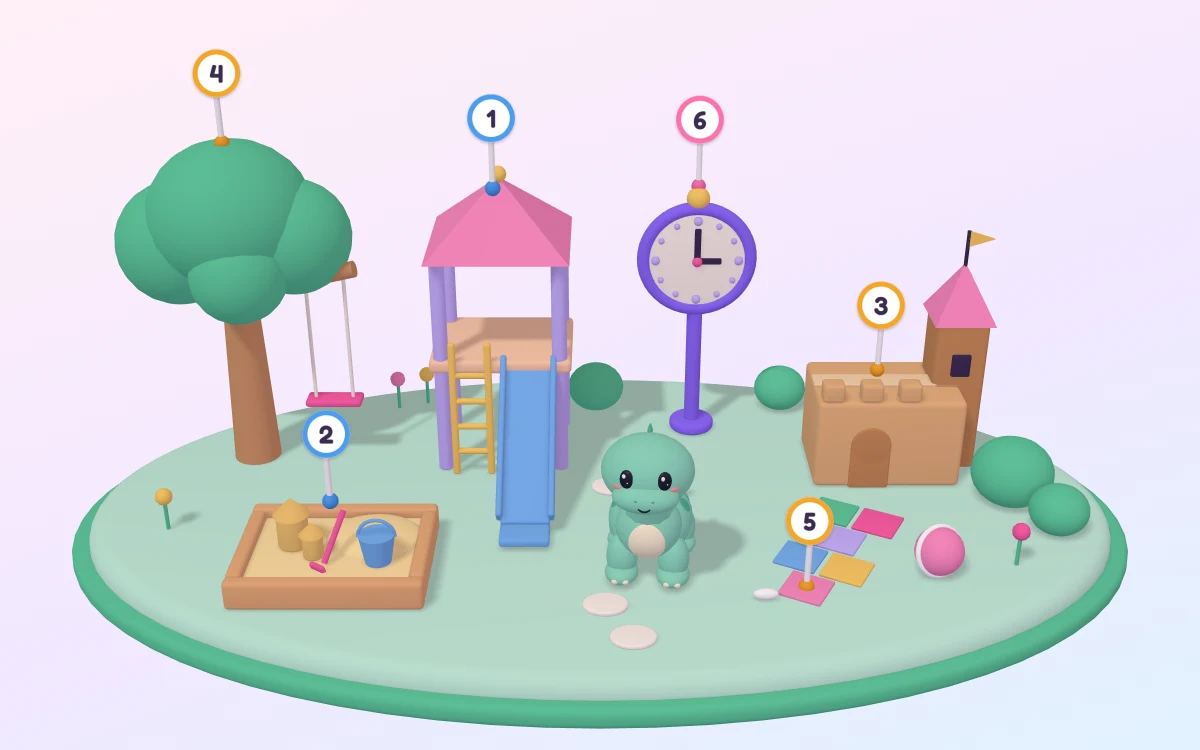
What free play is linked to
Each pin marks one benefit that research links to unstructured play, colored by how strong the evidence is. Nearly all of it is correlational.
- Some evidence
- Limited evidence
- Unverified or untested
1. Movement and motor skillsEvidence: Reviews (some evidence)
Active free play counts toward daily activity targets, and the 2018 AAP report ties play to foundational motor skills. A systematic review of 21 papers (Brussoni and colleagues, 2015) found risky outdoor play went with better health outcomes, physical activity above all, and called for more high-quality research.
2. Self-regulationEvidence: Long-term, correlational (some evidence)
In 2,213 Australian children, toddlers and preschoolers with more unstructured quiet play had better self-regulation two years later, even after accounting for earlier self-regulation (Colliver and colleagues, 2022). That is an association, not proof of cause.
3. Self-directed thinkingEvidence: One small study (limited evidence)
Parents of 70 six-year-olds logged a week of their child's time. More less-structured time went with better self-directed switching: steering their own thinking without an adult's prompts (Barker and colleagues, 2014). The link was modest, and children already good at self-direction may simply get more free time.
4. Mood and copingEvidence: Small links, correlational (limited evidence)
Children who did more adventurous play (child-led, with some thrill and age-appropriate risk) had slightly fewer anxiety and low-mood symptoms (Dodd and colleagues, 2022). Peter Gray's case that lost free play helped drive rising anxiety and depression is a serious argument from trends, not a tested finding.
5. Social skills and funEvidence: Mostly expert reviews (limited evidence)
Negotiating rules and turns, and plain enjoyment. Support here comes mostly from expert reviews like the AAP's. Kids will argue over rules and turns; step in if someone is getting hurt or repeatedly shut out.
6. How much free play does a child need?Evidence: No set number (unverified or untested)
No government guideline sets free-play minutes. The WHO's 180 minutes a day for ages 1 to 4 and the US 60 minutes for ages 6 to 17 are physical activity targets. Our suggestion, not a research-based number: some child-chosen time most days and one longer, unhurried block a week.
Pediatricians have long argued for the importance of unstructured play. Kenneth Ginsburg's 2007 AAP report warned that busy schedules and academic pressure were squeezing some children's free time, and The Power of Play (2018), by Michael Yogman and colleagues, asks pediatricians to “advocate for the protection of children's unstructured playtime.” Both are expert reviews, not new experiments, and the 2018 report notes that most research on play and brain structure has been done in rats.
Does unstructured play build executive function? The studies
In a widely cited study from Yuko Munakata's lab, then at the University of Colorado Boulder, Jane Barker and colleagues (2014) had parents of 70 six-year-olds log a week of their child's time outside school. In a one-minute word game (name as many foods as you can), children who cluster related words and then switch clusters unprompted show what the researchers call self-directed executive function: steering your own thinking toward a goal without an adult's prompts.
More less-structured time (here including reading, outings and screens; the result held without screens) went with better self-directed switching, after accounting for age, vocabulary and household income; more structured time went with somewhat weaker switching, though that result was only borderline. Neither predicted scores on tasks where instructions tell the child exactly what to do. The link was modest and didn't show up at all in the oldest quarter of the children.
| Study | Design | Who was studied | What it found |
|---|---|---|---|
| Barker and colleagues (2014) | Correlational; one week of parent logs | 70 six-year-olds (mean age 6.6), mostly affluent suburban Colorado families | More less-structured time, better self-directed switching |
| Stucke and colleagues (2022) | Correlational; online, early in the COVID-19 pandemic | 93 children aged 3–5 | More, and more varied, less-structured time (caregivers more involved), better rule-switching on a card game, an instruction-led task unlike Barker's |
| Colliver and colleagues (2022) | Longitudinal; parent time-use diaries | 2,213 Australian children, first studied at ages 2–3 and 4–5 | More unstructured quiet play predicted better self-regulation two years later, even after accounting for earlier self-regulation |
| Barker and colleagues (2021, preprint) | Longitudinal twin study | 936 twins, ages 3–4 to 7 | More structured homes and activities early, weaker self-directed switching at 7 |
Has it replicated? Related results appear at other ages and in Australia, but the studies measure different skills; Stucke's card game is the instruction-led kind of task Barker's measure didn't predict. All four studies are observational, so children already good at self-direction may simply get more free time; the twin study tries hardest to untangle that, and as far as we can find it is still a preprint.
Free play and mental health: a strong argument, not settled science
The boldest claim comes from Peter Gray of Boston College. In a 2011 American Journal of Play paper, he set two US trends side by side: children's free play declined from about the mid-1950s, while anxiety, depression and helplessness in young people rose. He argued the first helped cause the second, because self-directed play is where children practice making decisions, handling feelings and settling disputes.
In 2023, Gray, anthropologist David Lancy and psychologist David Bjorklund widened the argument in The Journal of Pediatrics to independent activity in general: roaming, getting around alone and taking on real responsibilities without adults in charge. In England, for example, the share of elementary-age children allowed to get home from school on their own fell from 86% in 1971 to 25% by 2010. It is a review, not a new study; the authors say most of their evidence is correlational and call lost independence a cause, possibly a major one, but not the only one, pointing to school pressure too. They argue reviews give little support to smartphones and social media as a major cause (citing Odgers and Jensen, 2020, and Orben, 2020); the cause is still debated.
Newer data fit part of the argument, weakly. Helen Dodd and colleagues (2022) surveyed two samples of UK parents of children aged 5–11, including a nationally representative 1,919. Children who did more adventurous play (child-led, with some thrill and age-appropriate risk) had slightly fewer anxiety and low-mood symptoms. Low-adventure play showed no such link, and sometimes more of it went with more symptoms, so the finding is about adventurous play, not playtime in general. The links were small, the data were one-time parent reports, and anxious children may simply play less adventurously.
This article is general information, not medical advice. If you are worried about your child's anxiety, mood or development, talk with your pediatrician.
How much playtime does a child need?
No government health guideline sets minutes per day for unstructured play, and the AAP asks for it to be protected without naming a number. Circulating figures are for physical activity:
- Ages 1–4 (WHO, 2019): at least 180 minutes a day of activity at any intensity; for ages 3–4, at least 60 of those minutes moderate to vigorous.
- Ages 6–17 (US HHS, 2018): 60 minutes or more of moderate-to-vigorous activity daily.
Colliver's study linked one to five hours of preschoolers' active free play to better self-regulation later, but it wasn't designed to set a target. Barker's six-year-olds averaged about 32 hours a week of less-structured time, screens included, in that mostly affluent sample, so for many families the bigger question may be what fills the open hours. Our suggestion, not a research-based number: some child-chosen time most days, one longer unhurried block a week, and regular time outdoors and with other kids. If screens swallow that time, see our screen time chart and family media plan.
Are there disadvantages to unstructured play? Limits and real downsides
What the research does not show
- Cause and effect. We found no randomized trial that gave families more free time and compared outcomes.
- That structured activities harm kids. Joseph Mahoney and Andrea Vest (2012) followed 1,115 US youth aged 12–18, a nationally representative group, into young adulthood. More hours in organized activities predicted better outcomes, such as flourishing and educational attainment, and no more distress or substance use. These were teens, but the point is balance.
Real downsides to plan for
- Getting started. Boredom or a beeline for a screen is common, so set out materials or an idea, then step back.
- Conflict. Kids will argue over rules and turns; step in if someone is getting hurt or repeatedly shut out.
- Risk. A systematic review of 21 papers by Mariana Brussoni and colleagues (2015) concluded that, on balance, risky outdoor play went with better health outcomes, physical activity above all, and called for more high-quality research. Gray and colleagues suggest teaching safety skills, such as crossing streets and bike rules, instead of ruling out independence. Match freedom to your child's age and neighborhood.
Protecting play when kids are overscheduled
Before cutting anything, map your week. An illustrative example:
| Day (example) | Adult-led | Child-led | Screens |
|---|---|---|---|
| Monday | Swim lesson, homework | 20 minutes of Lego | 1 hour |
| Wednesday | Piano, homework, chores | None | 1 hour |
| Saturday | Soccer game | Park and fort building | 2 hours |
Here, Wednesday has no child-led time; moving one activity or swapping some screen time for an open block fixes it. If you use a chore chart, keep it to a short list of have-to tasks so free time stays free, and leave off play your child already loves (our review of whether reward charts work explains why). Our after-school routine checklist builds play into the afternoon, and in summer a few morning jobs leave the rest of the day open. See more in our play and learning hub.
Try this at home
- Log one ordinary week. Mark each afternoon and weekend block as adult-led, child-led or screens.
- Protect one block. Write free time on the calendar for one weekday afternoon so it doesn't quietly fill up.
- Set up, then step back. Leave out boxes, tape, chalk, blocks or dress-up clothes. Example script: “I'm making dinner. This bin is all yours; I'll check in when the timer goes off.”
- Let boredom sit. Example script: “Bored is an OK feeling. You've got the yard, the art bin and the box pile. What do you want to try?”
- Add independence in small steps, such as, for an older child, a walk to a nearby park with a sibling once safety rules are practiced.
- Ask about recess if your child's school withholds it as a consequence. The AAP's 2013 policy statement says recess shouldn't be withheld for punishment or schoolwork, and a 2026 revision re-emphasizes its role.
Keep the have-to list short
Star Chart Kids is a free chore and routine chart for families with kids roughly 3–12. Group a few after-school tasks into a quest and set them to repeat only on the weekdays you choose, so lesson days stay light. No ads, streaks or leaderboards. It won't create free play, but it can keep the checklist quick so the rest of the afternoon stays open. A parent creates a username and parent passcode; no email or payment required.
Frequently asked questions
How much unstructured play does a child need per day?
No government health guideline sets minutes for free play. The WHO's 180 minutes of activity a day for ages 1 to 4 and the US guideline of 60 minutes of moderate-to-vigorous activity for ages 6 to 17 are physical activity targets. A practical aim is some child-chosen time most days and one longer, unhurried block a week.
What is the difference between structured and unstructured play?
In unstructured play, the child chooses what to do, how and when to stop, with adults nearby mainly for safety. Structured activities, such as lessons, practices and homework, follow an adult's goal and plan. Both have value; the concern is a week with no room for the first kind.
Are there disadvantages to unstructured play?
Some children need help getting started, kids playing together will argue, and active play brings bumps and scrapes. Free time that is mostly screens may not offer the same benefits. Setting out materials and teaching safety rules help.
What are the benefits of unstructured play for toddlers?
In a study of 2,213 Australian children, toddlers and preschoolers who spent more time in unstructured quiet play had better self-regulation two years later, even after accounting for earlier self-regulation. That is an association, not proof of cause.
Is it OK not to play with your child all the time?
Yes. The AAP stresses that playing together matters, especially for babies and toddlers, but free play also means time when adults aren't directing. Staying nearby and available while your child leads is a reasonable middle ground.
Sources and further reading
- The Power of Play: A Pediatric Role in Enhancing Development in Young Children (Pediatrics (Yogman, Garner, Hutchinson, Hirsh-Pasek & Golinkoff, 2018))
- The Importance of Play in Promoting Healthy Child Development and Maintaining Strong Parent-Child Bonds (Pediatrics (Ginsburg, 2007))
- The Crucial Role of Recess in School (Pediatrics (AAP Council on School Health; Murray, Ramstetter and colleagues, 2013))
- The Crucial Role of Recess in School: Policy Statement (Pediatrics (Murray, Ramstetter, Woolridge & Woodham Brickman, 2026))
- Less-structured time in children's daily lives predicts self-directed executive functioning (Frontiers in Psychology (Barker, Semenov, Michaelson, Provan, Snyder & Munakata, 2014))
- What are the kids doing? Exploring young children's activities at home and relations with externally cued executive function and child temperament (Developmental Science (Stucke, Stoet & Doebel, 2022))
- Environmental and genetic influences on self-directed executive functioning in childhood (PsyArXiv preprint, not peer reviewed (Barker, Van Deusen, Friedman & Munakata, 2021))
- Free play predicts self-regulation years later: Longitudinal evidence from a large Australian sample of toddlers and preschoolers (Early Childhood Research Quarterly (Colliver, Harrison, Brown & Humburg, 2022))
- The Decline of Play and the Rise of Psychopathology in Children and Adolescents (American Journal of Play (Gray, 2011))
- Decline in Independent Activity as a Cause of Decline in Children's Mental Well-being: Summary of the Evidence (The Journal of Pediatrics (Gray, Lancy & Bjorklund, 2023))
- Child's Play: Examining the Association Between Time Spent Playing and Child Mental Health (Child Psychiatry & Human Development (Dodd, Nesbit & FitzGibbon, 2022))
- The Over-Scheduling Hypothesis Revisited: Intensity of Organized Activity Participation During Adolescence and Young Adult Outcomes (Journal of Research on Adolescence (Mahoney & Vest, 2012))
- What is the Relationship between Risky Outdoor Play and Health in Children? A Systematic Review (International Journal of Environmental Research and Public Health (Brussoni and colleagues, 2015))
- To grow up healthy, children need to sit less and play more (World Health Organization (2019))
- Physical Activity Guidelines for Americans, 2nd edition: Executive Summary (U.S. Department of Health and Human Services (2018))