
← All blog articles · Rewards & Motivation topic hub
Quick answer: Do reward charts work? Often yes, at least while the chart runs, for a few tasks a child currently avoids: in a classroom token-chart study and a 422-child vegetable trial, rewards raised the targeted behavior. The catch, the overjustification effect, shows up in the big research reviews mainly when kids expect a tangible reward for something they already enjoy. Most reward chart research comes from short experiments and parenting programs, not long-term studies of home chore charts, so it can guide design but can't promise lasting change.
Key takeaways
- Rewards raised the targeted behavior in a classroom token-chart experiment while the chart was up. In a 422-child vegetable trial, children given stickers for tasting still ate more three months later than children who only tasted.
- Token systems are a core part of three of the five behavioral parent-training programs for disruptive behavior compared in a 2016 review.
- The overjustification effect appears mainly with expected, tangible rewards for activities a child already enjoys. For dull tasks, the big meta-analyses on both sides found no undermining effect, though one classroom study saw a post-chart drop.
- Plan the phase-out from the start, since gains don't always outlast the chart, and keep loved hobbies and kindness off it.
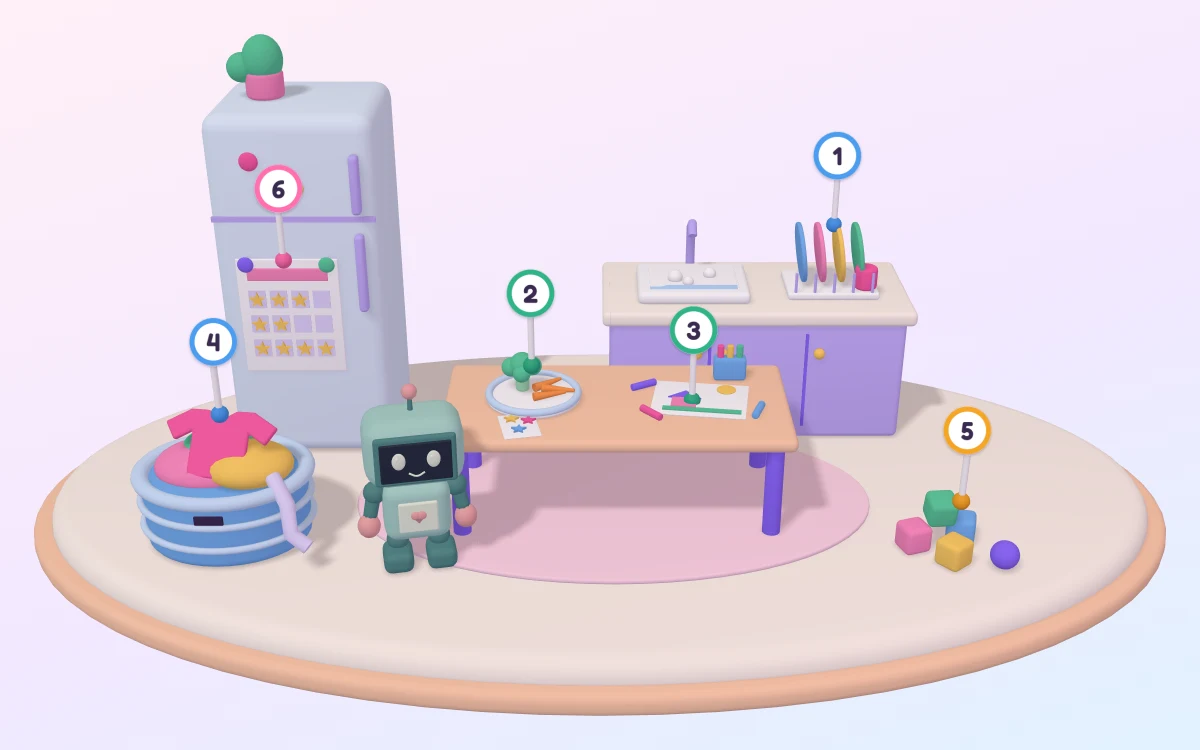
When rewards help and when they backfire
Each pin marks one finding from the reward research, colored by how strong the evidence is. The risky case is a promised prize for something a child already loves.
- Stronger evidence
- Some evidence
- Limited evidence
- Unverified or untested
1. Tasks your child avoidsEvidence: Experiments, short term (some evidence)
A reward chart is a home token economy. While a 1976 classroom chart was up, rewarded children spent significantly more time with their target math games, and token systems are a core part of three of the five parent-training programs compared in a 2016 review.
2. Stickers for tasting vegetablesEvidence: Randomized trial (stronger evidence)
In a trial with 422 children aged 4 to 6, kids tasted a disliked vegetable in 12 daily sessions. The gain in how much they ate lasted three months in both reward groups but faded with no reward; only the sticker group differed significantly from tasting alone (Cooke and colleagues, 2011).
3. The overjustification effectEvidence: Experiments, meta-analyses (stronger evidence)
Preschoolers who already liked drawing and drew for a promised certificate later spent less free time drawing (Lepper and colleagues, 1973). Across 128 experiments, rewards for interesting tasks lowered later free-choice motivation (Deci and colleagues, 1999). Keep loved activities off the chart.
4. Dull chores have little interest to loseEvidence: Meta-analyses, one exception (some evidence)
Pooling experiments, Deci's team found tangible rewards clearly undermined motivation for interesting tasks but had no significant effect on dull ones, and Cameron's group found rewards raised it. The 1976 classroom chart is a partial exception: after it came down, children spent less time with some of the rewarded games.
5. Keep kindness off the chartEvidence: One small lab study (limited evidence)
Toddlers around 20 months old had chances to help an adult, for example by picking up an object the adult had dropped. Those who had received a material reward for helping later helped less than toddlers who were praised or not rewarded (Warneken and Tomasello, 2008). It's a single lab study.
6. Design the chart, and its endingEvidence: Not tested at home (unverified or untested)
Pick one to three tasks your child currently avoids, give the star right away, keep favorites and kindness off it, and write down the exit plan before you start, since gains don't always outlast the chart. No study has tested a stand-alone home chart, so this is our reading of the findings, not a tested protocol.
Are reward charts effective? The evidence for
A reward chart is a home version of what psychologists call a token economy, in which a child collects stickers, points or stars and later trades them for something they want. By 1982, Alan Kazdin's review described token economies spreading widely, into treatment and rehabilitation programs, schools and community projects (Kazdin, 1982).
A 2016 review of five behavioral parent-training programs for children with disruptive behavior problems, all in the Hanf tradition, found token economies were a core component of three: COPE, Defiant Children and the Incredible Years. Parent-Child Interaction Therapy mentions them at its last session and doesn't treat them as a key part (Kaehler and colleagues, 2016).
Controlled experiments point the same way. In a cluster-randomized trial with 422 children aged 4 to 6 in UK schools, kids tasted a vegetable they disliked in 12 daily sessions, for a sticker, for praise or for no reward. Liking rose in all three tasting groups compared with untreated controls, and the gain in how much children ate lasted three months in both reward groups but faded in the no-reward group; only the sticker group differed significantly from tasting alone (Cooke and colleagues, 2011). In a 1976 classroom study, 44 fourth and fifth graders earned credit toward their school's math awards, tracked on a large wall chart, for time spent with particular math games. While the chart was up, all three rewarded groups spent significantly more time with their target games than comparison children, who could earn the same credit for any of the four games (Greene and colleagues, 1976).
One caveat: rewards are rarely the whole intervention. In a meta-analysis of 77 parent-training evaluations for children up to age 7, the components most consistently tied to bigger effects included more positive parent-child interaction, time-out, consistent parenting and parents rehearsing new skills with their child during sessions (Kaminski and colleagues, 2008). A chart works inside a warm, consistent routine; it doesn't replace one.
Can rewards backfire? The overjustification effect
In Mark Lepper and colleagues' 1973 experiment, nursery-school children who already liked a drawing activity were randomly assigned to draw for a promised "Good Player" certificate, to get it unexpectedly, or to get nothing (Lepper and colleagues, 1973). About two weeks later, those who had drawn for the promised award spent significantly less free time drawing than the other two groups, according to the team's later summary (Greene and colleagues, 1976). That is the overjustification effect: doing something to get an outside reward can lower later interest in the activity itself.
One major synthesis is Edward Deci and colleagues' 1999 meta-analysis of 128 experiments. In its main analyses of interesting tasks, rewards for doing, completing or doing well on a task all lowered later free-choice motivation (d = −0.40, −0.36 and −0.28 respectively, small-to-moderate effects), and tangible rewards did more damage to children's interest than to college students'. Positive feedback raised motivation overall, but in the seven experiments with children that boost was not statistically significant (Deci and colleagues, 1999).
A smaller experiment adds a caution for families. Thirty-six toddlers around 20 months old had chances to help an adult, for example by picking up an object the adult had dropped. Those who had received a material reward for helping later helped less than toddlers who had been praised or not rewarded (Warneken and Tomasello, 2008). It's a single lab study, but it's a good reason to keep spontaneous kindness off the chart.
The conditions matter. Some experiments, some of them with college students, tested an interesting task and a dull task side by side. Pooling those, Deci's team found tangible rewards clearly undermined free-choice motivation for the interesting tasks (d = −0.68, a moderate-to-large effect) and had no significant effect on the dull ones; their explanation: a boring task has little interest left to lose (Deci and colleagues, 1999). Plenty of kids feel nothing much about unloading the dishwasher, so a star for that chore starts a behavior rather than replacing a love of it.
Dull tasks aren't risk-free. Deci and colleagues argue the real question there is internalization: whether people come to value and own the task. More broadly, they argue that using rewards to control behavior can keep children from learning to motivate themselves (Deci and colleagues, 1999), one more reason to treat a chart as temporary. Our post on how to encourage intrinsic motivation in children looks at what helps a task become a child's own.
Do rewards kill motivation? Where both camps agree
Judy Cameron and W. David Pierce lead the main counter-view. Their 1994 meta-analysis of 96 experiments found no overall loss of intrinsic motivation from rewards, a boost from verbal praise, and one exception: a small decline when people were promised a tangible reward just for taking part in a task (Cameron and Pierce, 1994). Deci's 1999 analysis was partly a reply, arguing that pooling interesting and dull tasks had blurred the picture (Deci and colleagues, 1999). Their 2001 follow-up with Katherine Banko found that rewards raised free-choice motivation on low-interest tasks and harmed it on enjoyable tasks only when the reward was tangible, announced in advance and barely linked to how well the person did (Cameron and colleagues, 2001).
The camps still disagree on the effect's size and on rewards tied to performance, but their findings overlap on what matters most at home:
- The risky case is the same. Both find the clearest harm from expected, tangible rewards for an activity a child already enjoys. Reading for pleasure, drawing and self-driven practice are better left off the chart.
- Dull tasks are a different case. In the meta-analyses, neither camp found that rewards undermine motivation for low-interest tasks, and Cameron's group found they raised it. The one classroom token-economy study here is a partial exception (see the spotlight above).
What reward chart research doesn't show
- Whether gains outlast the chart. Kazdin's 1982 review counted making gains last, and carry over to new settings, among the token economy's long-standing obstacles. Later results point both ways: the classroom study's post-chart drop hit the least-played and self-chosen games, while the vegetable trial's reward groups still ate more at three months.
- How long to keep a chart going. None of these studies tested how many weeks a home chart should run, and the best-known habit-timing data come from adults and vary widely; our post on how long it takes a child to form a habit walks through what is and isn't known.
- Whether to take stars away. Programs differ. COPE and Defiant Children include fines, such as deducting tokens, as a backup when a child refuses time-out, while the Incredible Years doesn't recommend removing earned tokens, reportedly so that rewards and discipline stay separate (Kaehler and colleagues, 2016). With no head-to-head test for home charts, treat this as a values choice, not settled science.
This article is general information, not medical advice. If you're worried about frequent or intense behavior problems, talk with your pediatrician.
What it means for a reward chart at home
No study we found has tested a stand-alone home reward chart, so the steps below are our reading of the findings, not a tested protocol. The working rules we recommend (immediate, specific, never taken away as punishment, reachable and celebrated) are unpacked in our reward chart guide. What goes on the prize side matters too: experiences and privileges over escalating stuff (build a printable reward menu with your own star prices).
Try this at home
- Pick one to three tasks your child currently avoids and name each one precisely: "teeth brushed before story time," not "be good at bedtime."
- Leave favorites and kindness off. Drawing, reading for fun and helping a sibling stay unpriced.
- Give the star right away and say what they did. Example script: "You brushed the back teeth too."
- Make the first reward reachable within a few days so the system feels winnable.
- Keep consequences separate. If misbehavior needs a consequence, use a different one rather than erasing earned stars.
- Write down your exit plan before you start, such as lowering a task's stars once it's steady, then moving it off the chart while keeping the praise.
Praise matters too: specific, "labeled" praise is a core parenting skill in programs such as Parent-Child Interaction Therapy (Kaehler and colleagues, 2016); our positive reinforcement examples show what that sounds like. If a well-designed chart still isn't moving, the problem may not be motivation: run the diagnostic in my kid won't do chores, or browse the rewards and motivation hub.
If you'd rather run it in an app
Star Chart Kids, the app we make, is one optional way to run a chart like this: a free web app for roughly ages 3 to 12, where a parent creates a username and parent passcode (no email or payment required). Kids tap a parent-defined task when it's done; the star lands right away, or after your OK if that task needs approval. Stars buy cosmetic rewards such as avatar outfits and pets, or real-life rewards you define; requesting one reserves the stars until you approve, with a refund if you decline. There are no ads, loot boxes, streaks or leaderboards, and the app doesn't take earned stars away as punishment, a choice in line with the Incredible Years approach rather than a proven advantage. To phase a task out, lower its stars or schedule it on fewer days.
Frequently asked questions
Will a reward chart make my child expect rewards for everything?
It can if everything gets a price. The overjustification research suggests keeping activities your child already enjoys, and spontaneous kindness, off the chart, and using stars for a few specific tasks they currently avoid. Planning each task's exit from the start keeps the system temporary.
At what age do reward charts stop working?
No study defines a cutoff. The individual child experiments discussed here ran from 20-month-olds to fourth and fifth graders (roughly ages 9 to 11), and the 1999 meta-analysis found tangible rewards did more damage to children's interest than to college students'. For older kids, points and privileges instead of stickers and prizes may fit better, though none of these studies tested that.
Is a digital reward chart better than a paper one?
We haven't found studies comparing digital and paper reward charts directly. Pick the format your family will run consistently: paper is visible on the wall and needs no setup, while an app can reset daily and keep the tally for you.
What is the overjustification effect in kids?
It's the finding that expecting a reward for an activity a child already enjoys can lower their interest in it once the reward stops. In a classic 1973 experiment, preschoolers who drew for a promised certificate later drew less in free time than children who weren't promised one. It hasn't shown up reliably for dull tasks.
Sources and further reading
- Undermining children's intrinsic interest with extrinsic reward: A test of the "overjustification" hypothesis (Journal of Personality and Social Psychology (Lepper, Greene & Nisbett, 1973))
- Overjustification in a token economy (Journal of Personality and Social Psychology (Greene, Sternberg & Lepper, 1976))
- A meta-analytic review of experiments examining the effects of extrinsic rewards on intrinsic motivation (Psychological Bulletin (Deci, Koestner & Ryan, 1999))
- Reinforcement, Reward, and Intrinsic Motivation: A Meta-Analysis (Review of Educational Research (Cameron & Pierce, 1994))
- Pervasive negative effects of rewards on intrinsic motivation: The myth continues (The Behavior Analyst (Cameron, Banko & Pierce, 2001))
- Extrinsic rewards undermine altruistic tendencies in 20-month-olds (Developmental Psychology (Warneken & Tomasello, 2008))
- Eating for Pleasure or Profit: The Effect of Incentives on Children's Enjoyment of Vegetables (Psychological Science (Cooke and colleagues, 2011))
- The token economy: A decade later (Journal of Applied Behavior Analysis (Kazdin, 1982))
- Distilling Common History and Practice Elements to Inform Dissemination: Hanf-Model BPT Programs as an Example (Clinical Child and Family Psychology Review (Kaehler, Jacobs & Jones, 2016))
- A Meta-analytic Review of Components Associated with Parent Training Program Effectiveness (Journal of Abnormal Child Psychology (Kaminski, Valle, Filene & Boyle, 2008))