
← All blog articles · Play & Learning topic hub
Quick answer: Do fewer toys make kids happier? Nobody has measured that. The popular claim traces back to one 2018 lab study of 36 toddlers, which found that with 4 toys in the room instead of 16, toddlers played longer with each toy and in more varied ways. That is a finding about focus and play, not happiness, and it comes from a single small study that, as far as we could find, has not been directly replicated.
Key takeaways
- The viral "fewer toys" headline rests mainly on Dauch and colleagues (2018): 36 toddlers aged 18 to 30 months, each observed once with 4 toys and once with 16.
- With fewer toys, toddlers switched toys less often, stayed with each toy longer and played with it in more ways. Happiness was never measured.
- A separate classroom experiment found kindergartners were more distracted and learned less in a heavily decorated room, which fits the idea that a busy space splits young children's attention.
- No study gives a "right" number of toys, and toy rotation has not been tested directly. It is a reasonable way to try the idea at home.
- For gifts, children up to age 12 in one 2020 paper got more happiness from things than from experiences. The case for fewer toys at once is about play, not about withholding gifts.
Where the "fewer toys make kids happier" claim comes from
Parenting sites have run headlines saying toddlers are happier with fewer toys for years. The study usually cited is The influence of the number of toys in the environment on toddlers' play, published in 2018 in Infant Behavior and Development by Carly Dauch, Michelle Imwalle, Brooke Ocasio and Alexia Metz of the University of Toledo's occupational therapy doctoral program.
The paper's own claim is narrower than the headlines. The authors tested whether an environment with fewer toys leads to higher quality play, and they described their result in terms of focus, exploration and creative play. The word "happier" came later, in the retelling.
Inside the 4-toy vs 16-toy study
Each of the 36 toddlers came to a university playroom twice for a supervised, individual free play session of about 15 minutes. In one visit the room held 4 toys; in the other it held 16. The researchers scored three things: how many separate times a child picked up and played with a toy, how long each bout of play lasted, and how many different ways the child used a toy.
The pattern was clear in this sample. With 4 toys, toddlers had fewer separate bouts of toy play, longer bouts with each toy, and a greater variety of ways of playing. With 16 toys, they moved from toy to toy more often. The authors suggested that fewer toys let toddlers focus, explore and play more creatively, and that families could try this in everyday settings.
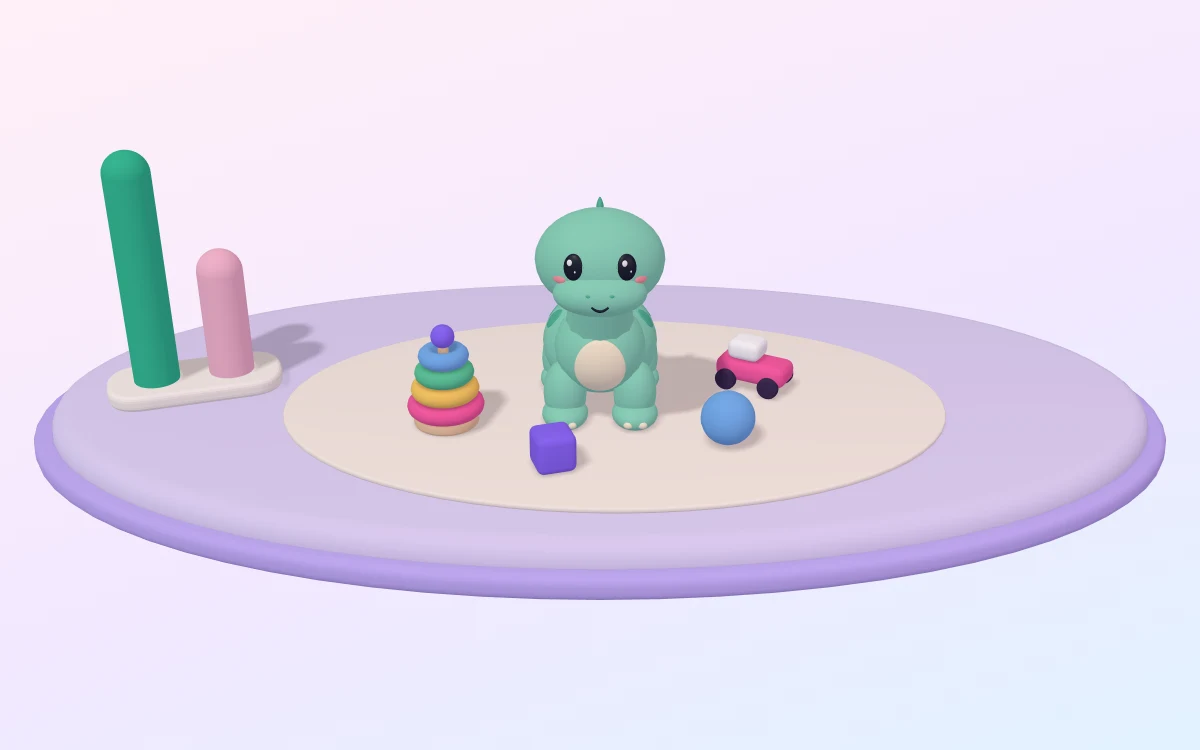
4 toys · Play time with each toy: Longer play with each toy. Fewer switches between toys and more varied ways of playing with each one.
This is a small, within-child experiment: every toddler tried both conditions, which helps rule out differences between children. It is the kind of study that produces a useful idea, not a settled rule.
What the study didn't measure
Before you clear out the playroom, it helps to know the limits:
- No happiness measure. The study recorded play behavior. It did not ask about mood, crying, frustration or contentment, so "happier" is an inference that the data cannot support or rule out.
- One small sample. 36 toddlers in one city, two short sessions each. We found no direct replication as of October 2026.
- Not their own toys. The toys used in the sessions were not the children's own. New toys are more exciting than familiar ones, and a room full of new things may pull attention more than a child's own shelf does. The British Psychological Society's Research Digest raised this point in its 2018 write-up of the study.
- Short-term only. The study shows what happened within a session. It says nothing about development, learning or behavior weeks or years later.
- One age band. The children were 18 to 30 months old. Older children, who can plan longer games that combine many toys, may respond differently.
So are too many toys bad for kids? This study can't say. None of this makes the finding wrong. It means the honest summary is "in one lab study, toddlers played with each toy longer when fewer toys were out," not "fewer toys make kids happier."
Why a busy room can split young children's attention
A separate line of research helps explain why the number of things in view might matter. In a 2014 experiment published in Psychological Science, Anna Fisher, Karrie Godwin and Howard Seltman of Carnegie Mellon University taught 24 kindergartners six short science lessons in a laboratory classroom. For some lessons the walls were heavily decorated with posters and displays; for others the decorations were removed. In the decorated room, children were more distracted by the surroundings, spent more time off task and showed smaller learning gains.
There is a fair debate about how lasting that effect is. In a commentary, psychologists Kana Imuta and Damian Scarf reanalyzed the 2014 data and found that the time children spent distracted by the decorated walls dropped considerably across lessons, which suggests that novelty explains part of the effect and that children may partly get used to a busy room. Even so, the decorated room was still more distracting than the bare one by the third lesson. A newer study by Godwin and Fisher, published in 2026 with 23 kindergartners, found that the more time children spent off task, the better they remembered the classroom displays and the worse they did on the lesson tests. That is a correlation, not proof of cause, but it fits the idea that attention spent on the surroundings is attention taken from the task.
These are classroom studies with kindergartners, not playroom studies with toddlers, and walls are not toys. Taken together with the toy study, though, they point the same way: for young children, a lot of competing visual stuff can make it harder to settle into one thing.
How many toys should a toddler have?
No study tells you how many toys a child should have, and the 4-versus-16 contrast was a lab comparison rather than a recommendation. The research says more about how toys are used than how many a child owns.
Two findings are worth knowing. In a 2016 experiment published in JAMA Pediatrics, Anna Sosa recorded 26 parents playing at home with their 10- to 16-month-old babies using electronic toys, traditional toys such as blocks and shape sorters, and books. During play with electronic toys, parents said fewer words, responded less and took fewer conversational turns with their babies than during play with traditional toys or books. And a clinical report from the American Academy of Pediatrics on choosing toys (Healey, Mendelsohn and colleagues, 2019) emphasizes the value of toys as a way for caregivers and children to play together with language, pretending and problem-solving, and notes the lack of evidence that digital "toys" offer similar benefits.
So a reasonable reading is: a few simple, open-ended toys that you sometimes play with together may do as much as a big pile, but no research tells you where "enough" ends.
Toy rotation: a simple system
Toy rotation is a popular way to put the fewer-toys idea into practice, sometimes summed up as fewer toys, better play. We found no study that tests rotation itself, so treat it as a sensible experiment rather than a proven method. An illustrative setup:
- Sort. Group toys loosely by type: building, pretend, movement, puzzles and books.
- Pick a small set. Put out a handful, with something from a few different groups, on a low shelf or in open bins your child can reach.
- Store the rest out of sight. Closed boxes in a closet keep the extras out of view.
- Swap a few at a time. When interest in something fades, trade one or two toys rather than the whole set, so favorites stay put.
- Watch, then adjust. If your child seems bored or frustrated, add a toy. If they flit between things, try removing a couple.
Tidying the small set away at the end of the day is also a natural first job for little kids; see our guide to chores for toddlers and the wider list of age-appropriate chores.
Gift season: more toys, fewer toys, or experiences?
A common follow-up to "fewer toys" is "give experiences instead." The evidence is more mixed than that advice suggests. In a 2020 paper in the International Journal of Research in Marketing, Lan Nguyen Chaplin, Tina Lowrey, Ayalla Ruvio, L. J. Shrum and Kathleen Vohs ran four studies with children and adolescents aged 3 to 17. Children aged 3 to 12 got more happiness from material goods than from experiences. The happiness children got from experiences grew with age, until older teens matched the adult pattern and reported more happiness from experiences than from things. The authors linked the shift to growing memory and theory of mind, the ability to understand other people's thoughts and feelings.
That gives you a balanced plan for the holidays. A new toy may genuinely delight a young child, and there is nothing wrong with that. Fewer toys at once is about better play, not about denying gifts. You can open presents, put a few out now, and save the rest for later rotation. Experiences such as a zoo trip or baking together are still lovely gifts; just know that, on average, younger children in that research got more happiness from things. For more gift-free ways to celebrate effort, our list of non-toy reward ideas for kids has plenty.
This article is general information, not medical advice. If you are concerned about your child's attention, play or development, talk with your pediatrician.
Try this at home
- Count the toys within your toddler's reach right now. Just notice; no need to purge.
- Box up most of them and leave a small, mixed set out for a week.
- Watch one ordinary play session. Does your child stay with one toy longer, or play with it in new ways?
- Swap one or two toys when interest fades, rather than the whole set.
- Sit down and play together for a few minutes each day. Talk about what your child is doing; simple toys and books leave room for that.
- After a gift-giving holiday, put a few new toys out and store the rest to rotate in over the coming weeks.
Make tidy-up and experiences part of the week
If you want a light structure around this, Star Chart Kids is one optional tool: a parent can add "put toys back on the shelf" as a step in a Bedtime quest, and set up real-life rewards that are experiences, like a park trip or baking together, rather than more things. It's free and best for ages 3–12. A parent creates a username and parent passcode (no email or payment required), and there are no ads, loot boxes or streaks.
For more on play and attention, see our play and learning hub, the research on the benefits of unstructured play, and these guided play examples.
Frequently asked questions
Do fewer toys really make kids happier?
No study has tested that directly. The 2018 study behind the claim measured how 36 toddlers played, not how happy they were. With 4 toys out instead of 16, they played longer with each toy and in more varied ways.
How many toys should a toddler have out at one time?
There is no research-based number. The 2018 study compared 4 toys with 16 in a lab playroom and did not test other amounts. Many families keep a small handful out and rotate the rest, which follows the same idea but has not been studied itself.
What is toy rotation?
Toy rotation means storing most toys out of sight, putting out a small set at a time and swapping some of them every so often. It is a practical way to apply the fewer-toys-at-once finding, but no study has tested rotation itself.
Are experiences better gifts than toys for young kids?
Not necessarily. In a 2020 paper with four studies of 3- to 17-year-olds, children up to age 12 got more happiness from material goods than from experiences, and only older teens reported more happiness from experiences.
Sources and further reading
- The influence of the number of toys in the environment on toddlers' play (Infant Behavior and Development (Dauch, Imwalle, Ocasio & Metz, 2018))
- Visual Environment, Attention Allocation, and Learning in Young Children (Psychological Science (Fisher, Godwin & Seltman, 2014))
- When too much of a novel thing may be what's "bad": commentary on Fisher, Godwin, and Seltman (2014) (Frontiers in Psychology (Imuta & Scarf, 2014))
- Inattention and the Classroom Visual Environment: Evidence of Incidental Learning (Mind, Brain, and Education (Godwin & Fisher, 2026))
- Association of the Type of Toy Used During Play With the Quantity and Quality of Parent-Infant Communication (JAMA Pediatrics (Sosa, 2016))
- Selecting Appropriate Toys for Young Children in the Digital Era (Pediatrics, AAP clinical report (Healey, Mendelsohn & Council on Early Childhood, 2019))
- Age differences in children's happiness from material goods and experiences: The role of memory and theory of mind (International Journal of Research in Marketing (Chaplin, Lowrey, Ruvio, Shrum & Vohs, 2020))
- Over-abundance of toys may stifle toddler creativity (BPS Research Digest (British Psychological Society, 2018))