
← All blog articles · Play & Learning topic hub
Quick answer: Guided play examples share one shape: an adult sets up a playful activity with a learning goal in mind, then lets the child lead it. Sorting socks by color, a shape hunt around the house, or building with blocks while you talk about "under," "behind" and "taller" all count. A 2022 meta-analysis found that guided play beat direct teaching on a few early math and thinking skills, but the studies were small, mostly in schools and labs, and showed no difference on most other outcomes.
Key takeaways
- Guided play sits between free play and direct teaching: the adult shapes the setup and keeps a goal in mind, and the child keeps real choice over what happens.
- A 2022 review of 39 studies (17 pooled, 3,893 children aged 1 to 8) found guided play did better than direct instruction on early math, shape knowledge and task switching, and better than free play on spatial vocabulary.
- Those effects came from small groups of two or three studies each, with a risk of publication bias, and most guidance was given by researchers or teachers rather than parents.
- Teaching too much can backfire: preschoolers who were deliberately taught one function of a toy explored it less broadly afterward (Bonawitz and colleagues, 2011).
- At home, everyday jobs like laundry, cooking and tidying make easy guided play, as long as the child still gets to steer.
What is guided play?
Guided play is play with a gentle adult hand on it. In a 2013 paper, developmental psychologists Deena Skolnick Weisberg, Kathy Hirsh-Pasek and Roberta Golinkoff described it as lying midway between direct instruction and free play: the adult has a learning goal and shapes the environment, while the child keeps a large degree of control over the learning. Their argument, which is a review of evidence rather than a new experiment, is that this mix keeps children actively engaged while still pointing them toward something worth learning.
In practice there are two common forms. In one, the adult sets up the materials (a pile of mixed socks, a basket of shapes) and lets the child explore. In the other, the adult joins play the child has already started and adds a question, a hint or a small challenge. Either way, the child is still the one doing the thinking.
The play spectrum: guided play vs free play vs direct teaching
Jennifer Zosh, Hirsh-Pasek and colleagues proposed in 2018 that play is easier to study as a spectrum than as a yes-or-no category. At one end is free play, with no adult guidance. In the middle are guided play and games, where an adult offers purposeful support but the activity stays playful. At the far end is direct instruction, where the adult decides what happens and the child follows. This is a theory paper; its job is to give researchers and parents a shared vocabulary, not to rank one kind of play above the others.
| Type | Who chooses the activity | Is there a learning goal? | Home example |
|---|---|---|---|
| Free play | Child | No adult goal | Your child builds whatever they like with blocks |
| Guided play | Adult sets it up or joins in; child leads | Yes, held lightly by the adult | You ask, "Can you build a tower taller than the chair?" and talk about what is on top and underneath |
| Games | Adult or rules set the structure | Often | A board game that involves counting spaces |
| Direct teaching | Adult | Yes | You explain that a triangle has three sides and ask your child to repeat it |
The spectrum also explains why guided play vs free play is not a contest. Free play has its own case, which we cover in our look at the benefits of unstructured play. Guided play is a different tool for a different job: helping a child notice something specific while it still feels like play.
Does guided play help kids learn? What a 2022 meta-analysis found
The first systematic review and meta-analysis of guided play comes from Kayleigh Skene and colleagues at the University of Cambridge, published in Child Development in 2022. They reviewed 39 intervention studies published between 1977 and 2020 and pooled 17 of them, covering 3,893 children aged 1 to 8. To count as guided play, a study had to combine child choice, adult guidance (hints, open-ended questions, challenges, modeling or joining in) and a clear learning goal.
Compared with direct instruction, guided play had a larger positive effect on early math skills (an effect size, Hedges' g, of 0.24), shape knowledge (0.63) and task switching, a part of executive function (0.40). Compared with free play, it had a large effect on spatial and math vocabulary (0.93). For literacy, social-emotional skills, behavior regulation and the other outcomes they pooled, the review found no clear difference between guided play and direct instruction.
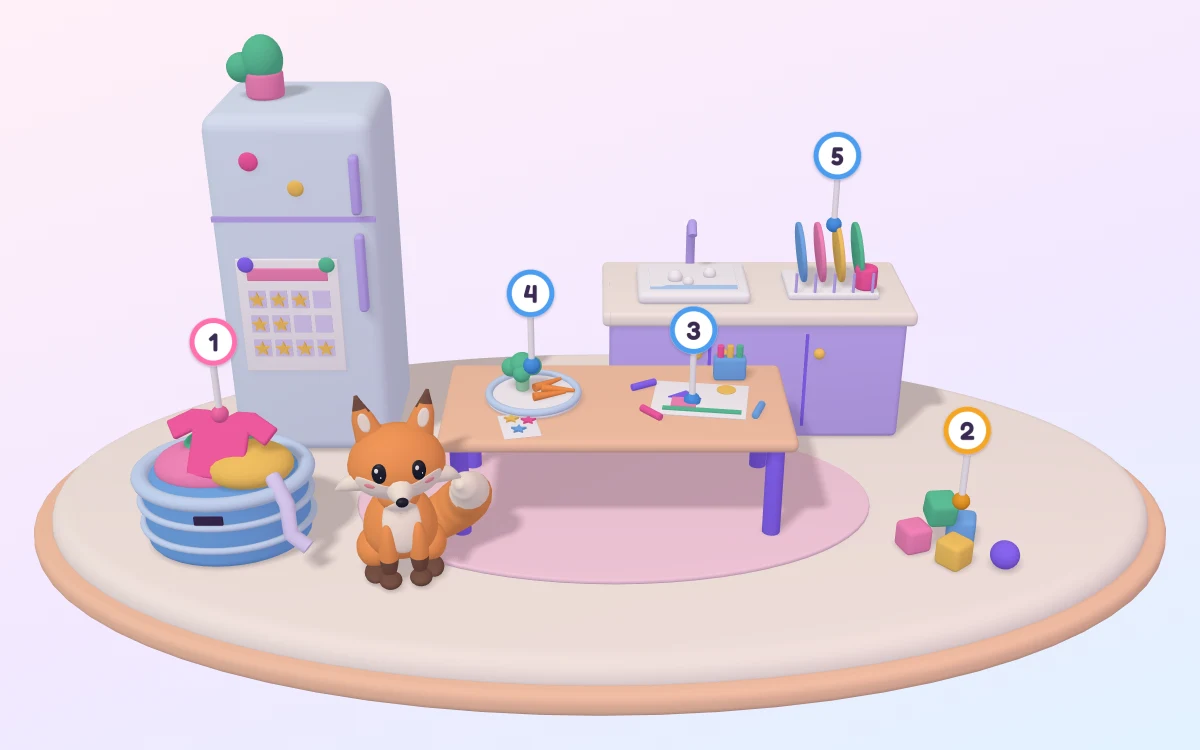
Guided play hides in everyday jobs
Each pin marks one guided play example and the research behind it, colored by how strong the evidence is. None of these home activities was tested directly.
- Some evidence
- Limited evidence
- Unverified or untested
1. Sock matchingEvidence: Illustrative example (unverified or untested)
Ask your child to find the pairs or sort by color. It is matching and sorting practice with a goal you hold lightly while they lead.
2. Block talkEvidence: Three small studies (limited evidence)
Build together and use words like under, next to and taller. Spatial and math vocabulary was where guided play pulled furthest ahead of free play (g = 0.93), though from three small studies.
3. Shape huntEvidence: Lab experiment (some evidence)
Hunt for secret triangles and ask how your child knows. In a small study of 70 four- and five-year-olds, guided play beat both free play and didactic teaching on shape knowledge, and the gain lasted a week.
4. Counting at the tableEvidence: Meta-analysis, small (some evidence)
How many plates do we need if a grandparent comes? Guided play beat direct instruction on early math skills (g = 0.24) in two pooled studies.
5. When to step backEvidence: Experiments (some evidence)
Preschoolers deliberately taught one function of a toy explored it less broadly afterward. Give the smallest hint that keeps your child going, then wait.
Those headline numbers need context. Each pooled result came from only two or three studies: the early-math result from two and the spatial-vocabulary result from three. The shape-knowledge result rested on 111 children, and the spatial-vocabulary result on 137. The authors rated many included studies at high risk of bias, found signs of publication bias, and noted that the larger effects tended to come from smaller studies. Most guidance was delivered by research teams (18 studies) or teachers (13), and only five studies used parents. The review was funded by an unrestricted donation from the LEGO Foundation, which has an obvious interest in play-based learning.
A study from Hirsh-Pasek's group shows what guided play can look like. Kelly Fisher and colleagues (2013) taught 70 four- and five-year-olds the properties of four shapes in one of three ways: guided play, free play or didactic instruction. Children in the guided-play group showed better shape knowledge than the other groups, and the difference was still there a week later. It was a single small study, so it is a useful illustration, not proof that the same thing happens at your kitchen table.
When teaching too much can limit exploration
Guidance has a cost if it tips into telling. In a set of experiments, Elizabeth Bonawitz, Laura Schulz and colleagues (2011) gave preschoolers a toy with several functions. When an adult deliberately taught one function, children focused almost entirely on that function. When the demonstration was interrupted, or came from an adult who seemed unfamiliar with the toy, children explored much more broadly. The researchers' interpretation is that children reasonably assume a teacher would have shown them everything worth knowing.
A broader review points the same way from the other side. Louis Alfieri and colleagues (2011) pooled 164 studies of teaching in general and found that explicit instruction generally beat unassisted discovery, while "enhanced" discovery, with feedback, worked examples, scaffolding or asking learners to explain, beat other approaches. That review was about instruction broadly, not about play or young children specifically, so it doesn't translate directly to the living room. Taken together, the pattern is consistent: neither leaving children entirely alone nor telling them everything is ideal for learning a specific idea. Light guidance tends to land in between.
Guided play examples by age
None of the studies above tested these specific activities. They are illustrative learning through play examples built on the same pattern: a playful setup, a goal you keep in your head, and a child who leads. Adjust them to your child rather than the age label.
- Toddlers (about 1 to 3): Put three socks of different colors in a basket and ask, "Can you find the one that matches mine?" Count stairs out loud together as you climb. Stack cups and wonder aloud, "Which one goes on top?"
- Preschoolers (about 3 to 5): Go on a shape hunt for "secret triangles" around the house, and ask how your child knows each one is a triangle. Build a block tower together and use spatial words like "under," "next to" and "taller." Let your child sort the clean cutlery into the drawer by type.
- Early school age (about 5 to 8): Ask your child to work out how many plates the table needs if a grandparent is coming. Let them plan a shop game with price tags and coins. Measure ingredients together and ask what would happen if you doubled the recipe.
Spatial words matter more than they might seem. In the Skene review, spatial and math vocabulary was the outcome where guided play pulled furthest ahead of free play (though not ahead of direct instruction, and based on just three small studies), and block play with an adult who talks about shapes and positions is one of the simplest ways to do it at home.
Turning everyday chores into guided play
Household jobs are full of sorting, counting, matching and planning, which makes them natural ground for guided play. Pairing socks is a matching game. Unloading groceries can be a "heaviest to lightest" challenge. Setting the table is counting and one-to-one matching. If you want ideas sized to your child's age, our guides to chores for toddlers and chores for preschoolers list jobs that young kids can genuinely do.
The "guided" part is what you add: a question ("How many forks do we need?"), a small challenge ("Can you find all the blue things?") or a bit of wondering out loud. The "play" part is that your child gets to choose how to do it, and that a wrong answer is part of the game rather than a mistake to fix. A chart or checklist can hold the chore itself, but the guidance comes from you, in the moment.
When to step back
The Bonawitz findings suggest a simple rule of thumb: offer the smallest hint that keeps your child going, then wait. Some signs it is time to back off:
- Your child has stopped exploring and is waiting for you to tell them the answer.
- You are doing more of the talking than they are.
- The game has lost its fun and feels like a test.
- Your child is absorbed in their own idea, even if it isn't the one you planned.
It is also fine for most play to have no adult goal at all. The AAP's 2018 clinical report on play, led by pediatrician Michael Yogman, encourages both shared play with caregivers and child-directed time. Guided play is one ingredient in a week, not a replacement for free play.
Try this at home
- Pick one everyday job this week, such as laundry, unpacking groceries or setting the table, and decide on one small idea to explore (colors, counting, bigger and smaller).
- Set it up so your child can lead: put the materials within reach and let them choose how to start.
- Use open questions instead of instructions. An illustrative script: "I wonder which of these is the heaviest. How could we find out?"
- Add spatial words as you play: on top, under, between, taller, shorter.
- If your child gets stuck, give the smallest hint you can, then pause and wait.
- Stop while it is still fun, and leave time afterward for play with no goal at all.
Make room for playful chores
Star Chart Kids is one optional way for a parent to add a few daily jobs, like matching socks or setting the table, to Morning, After-School or Bedtime quests for ages 3–12. It's free, a parent creates a username and parent passcode (no email or payment required), and there are no ads, streaks or leaderboards. The playful part still comes from the questions you ask along the way.
For more on this topic, see our play and learning hub, the research on why pretend play is important, and our summer chore ideas for kids.
Frequently asked questions
What is an example of guided play?
Setting out a basket of mixed socks and asking your child to find the pairs, or going on a shape hunt for triangles around the house. The adult sets up the activity with a learning goal in mind, and the child leads how it unfolds.
What is the difference between guided play and free play?
In free play, the child chooses everything and there is no adult goal. In guided play, an adult sets up the activity or joins in with questions and hints toward a learning goal, while the child still makes the choices. Both have a place in a child's week.
Is guided play better than direct instruction?
For a few skills, possibly. A 2022 meta-analysis found guided play did better than direct instruction on early math, shape knowledge and task switching, and found no clear difference for literacy or social skills. The pooled studies were small and mostly in schools and labs.
How do you do guided play at home?
Choose an everyday activity, keep one small learning idea in mind, and let your child lead. Ask open questions, add words like under, taller and between, offer the smallest hint when they get stuck, and stop while it is still fun.
Sources and further reading
- Guided Play: Where Curricular Goals Meet a Playful Pedagogy (Mind, Brain, and Education (Weisberg, Hirsh-Pasek & Golinkoff, 2013))
- Accessing the Inaccessible: Redefining Play as a Spectrum (Frontiers in Psychology (Zosh, Hirsh-Pasek, Hopkins and colleagues, 2018))
- Can guidance during play enhance children's learning and development in educational contexts? A systematic review and meta-analysis (Child Development (Skene, O'Farrelly, Byrne, Kirby, Stevens & Ramchandani, 2022))
- Taking Shape: Supporting Preschoolers' Acquisition of Geometric Knowledge Through Guided Play (Child Development (Fisher, Hirsh-Pasek, Newcombe & Golinkoff, 2013))
- The double-edged sword of pedagogy: Instruction limits spontaneous exploration and discovery (Cognition (Bonawitz, Shafto, Gweon, Goodman, Spelke & Schulz, 2011))
- Does discovery-based instruction enhance learning? (Journal of Educational Psychology (Alfieri, Brooks, Aldrich & Tenenbaum, 2011))
- The Power of Play: A Pediatric Role in Enhancing Development in Young Children (Pediatrics (Yogman, Garner, Hutchinson, Hirsh-Pasek & Golinkoff, 2018))