
← All blog articles · Kids’ Routines topic hub
Quick answer: The research on how to help a child with transitions points to three steps: make the next step predictable and visible, let them bring something along, and then follow through calmly so a meltdown does not cancel or delay the change. The common advice to give a warning has surprisingly mixed evidence: in several small studies, a two-minute warning on its own did not change what children did. All of this research uses tiny samples, often just two or three children, so treat it as a useful pattern rather than proof.
Key takeaways
- A transition has parts: ending something, starting something and often moving. Find out which part your child objects to, because the fix differs.
- Warnings alone did not help in three small studies of children without disabilities aged 14 months to about 5½ years. They seem to help most when surprise is the problem.
- In those studies, the change came when protesting no longer kept the fun going; in one study, praise or a small treat promised ahead of time for a calm switch was added.
- A comfort object for the trip helped two of three toddlers, but only once the transition reliably happened anyway.
Why do kids struggle with transitions?
Behavior analysts break a transition into pieces. In a 2001 study of two men with severe intellectual disabilities whose self-injury was tied to transitions, McCord, Thomson and Iwata separated at least three parts: ending the current activity, starting the next one, and moving from one place to another. For each person, the trouble came from a specific part, not from "change" in general.
Young children show the same split. David Wilder and colleagues (2006) tested eight kinds of transition with two preschoolers who had no diagnosed disability: a 34-month-old girl and a 40-month-old boy, with a parent leading each trial in a university clinic. For the girl, the trigger was ending something she loved: she had a tantrum in 100% of trials when her video was turned off. For the boy, the trigger was starting something he disliked, picking up items from the floor; the authors linked his tantrums to avoiding that task. Same complaint from the parent ("transitions are hard"), two different problems.
Two other lines of research help explain why stopping fun is so hard:
- Rich to lean. A review by Brewer and colleagues (2014) describes work, mostly in animals and in people with developmental disabilities, where moving from a very rewarding activity to a less rewarding one causes more stalling and escape than the same dull activity does on its own. Leaving the playground for the car is a rich-to-lean switch.
- Switching is a developing skill. In the Dimensional Change Card Sort, children sort cards by one rule, such as color, and are then told to switch to another, such as shape. Zelazo (2006) reports that most 3-year-olds keep using the old rule, while by 5 most switch. A meta-analysis of 69 reports and 426 task versions by Doebel and Zelazo (2015) found that switching was higher when the new rule was made more noticeable, tended to be higher when children named the cards themselves, and was lower after more rounds of the old rule. That is a lab card game, not a park exit, so treat the link to everyday transitions as a reasonable inference rather than a tested finding.
Do transition warnings work? What the studies found
A warning ("Two more minutes, then we go") is among the most common transition tips, and it is low-cost. The direct tests with typically developing children are not encouraging when the warning is used alone:
- Toddlers and the potty. Cote, Thompson and McKerchar (2005) worked with three toddlers, aged 14, 15 and 22 months, in a full-day program, all chosen because they often refused to leave play for the toileting area. A two-minute warning did not help, and neither did letting them bring a toy along: compliance stayed at or near zero.
- Preschool tantrums. In Wilder and colleagues' (2006) study, a parent told each child right before the trial that a change was coming and what it would be. Tantrums continued: the girl had one in every advance-notice trial, and so did the boy.
- Four- and five-year-olds. Wilder, Nicholson and Allison (2010) gave three boys aged 52 to 66 months notices at two minutes and one minute before asking them to hand over a favorite toy. Advance notice did not help any of the three. Strictly, that was a request rather than a change of activity, delivered by an adult the children did not know well.
The results are not uniformly negative. In a 2017 home study, Vasquez and colleagues found that a two-minute warning, a timer sound and the next activity's materials set out in front of her reduced problem behavior for a 7-year-old girl with autism whose trouble came from being interrupted. An older study with an autistic man (Tustin, 1995) reported less repetitive behavior when he got advance notice. Brewer and colleagues (2014) reviewed both sets of results and proposed a way to reconcile them: notice tends to work when the unpredictability of the change is what upsets the person, when protesting does not get the earlier activity back or put off the change, and when the warning comes in a form the person understands. In the studies where warnings failed, the transitions were probably already predictable, and a meltdown still paid off.
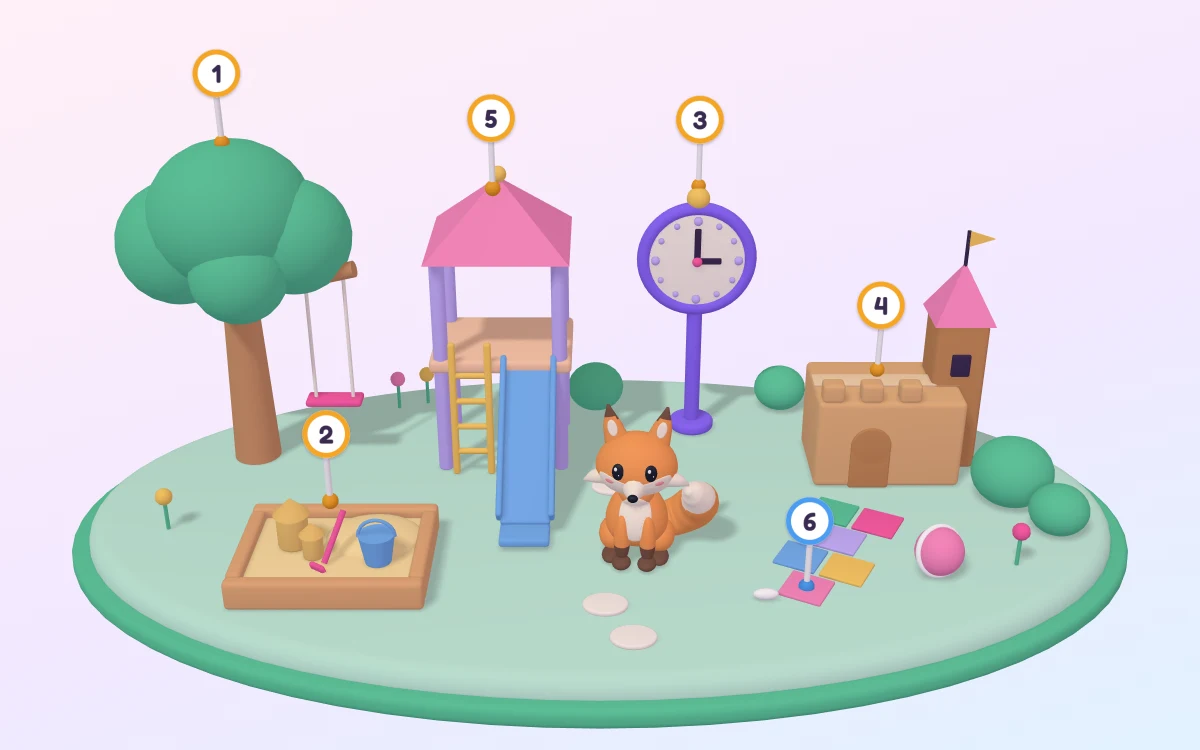
What makes leaving hard, and what helped
Each pin marks one part of a transition or one strategy the studies tested, colored by how strong the evidence is. Every study here is small.
- Some evidence
- Limited evidence
1. Ending something lovedEvidence: Two children (limited evidence)
For a 34-month-old girl, the trigger was a favorite activity ending: she had a tantrum in 100% of trials when her video was turned off (Wilder and colleagues, 2006).
2. Starting something dislikedEvidence: Two children (limited evidence)
For a 40-month-old boy in the same study, the trigger was starting a disliked task, picking up items from the floor. Same complaint, different problem.
3. A warning on its ownEvidence: Small studies, mixed (limited evidence)
Warnings given two minutes ahead, one minute ahead or just before the change did not, on their own, change compliance or tantrums in three small studies of children without disabilities. Warnings seem to help most when surprise is the problem.
4. Something to carry alongEvidence: Three toddlers (limited evidence)
A toy to bring along did not help toddlers on its own. Once the move reliably happened, it gave the best results for two of three.
5. Calm follow-throughEvidence: Small studies agree (limited evidence)
Across these studies, behavior changed when protesting no longer kept the fun going; one study also gave praise or a promised treat for a calm switch. All the studies are small.
6. Switching is still developingEvidence: Lab task, inference (some evidence)
In a card-sorting game, most 3-year-olds keep using an old rule after being told to switch, while most 5-year-olds switch. Switching tended to be higher in versions where children named the cards themselves. That is a lab game, not a park exit.
What actually helps a child transition between activities?
Across these small studies, the common ingredient was follow-through: protesting stopped working, and the transition went ahead even if the child cried or refused. Researchers call this extinction. In practice, an adult (a researcher, or in the 2006 study the child's parent) guided the child through the change with gestures and, if needed, a hand. In the 2006 study, a second part was added: calm behavior earned something: the girl in Wilder's study got enthusiastic praise for transitions without a tantrum, and the boy could pick from three favorite items, which he was told about before each trial. With both parts in place, the girl's tantrums gradually decreased and the boy's stopped. Because the boy had no tantrums at all once the plan started, the promised choice, announced beforehand, may have done more of the work for him than the follow-through.
The toddler study adds one detail. Once the move to the potty reliably happened, letting two of the three toddlers carry a toy along gave the best results, while the third did best with follow-through alone. A comfort object can soften a transition, but in this study it did not replace the transition actually happening.
Visual schedules followed the same pattern in a study by Waters, Lerman and Hovanetz (2009) with two children with autism: showing the schedule alone did not reduce problem behavior when moving from a favorite activity to a less favored one; follow-through plus rewards for calm behavior did, with or without the schedule. With only two children, it is a caution rather than a rule: a chart rarely does the work alone.
The planned reward deserves one more note. Promising a choice of treat before the transition, as in the 2006 study, is different from offering one in the middle of a meltdown to make it stop. The second pattern rewards the meltdown. The difference is covered in more detail in bribe vs reward.
How the studies were done, and what they can't tell you
| Study | Who | Warning alone | What helped |
|---|---|---|---|
| Cote, Thompson & McKerchar (2005) | 3 toddlers, 14 to 22 months, child care | No effect | Follow-through, plus a toy for 2 of 3 |
| Wilder et al. (2006) | 2 preschoolers, 34 and 40 months, clinic | No effect (notice given right before the trial) | Follow-through plus praise or a planned treat |
| Wilder, Nicholson & Allison (2010) | 3 boys, 4 to 5 years, school | No effect | Physical guidance |
| Waters, Lerman & Hovanetz (2009) | 2 boys with autism, age 6 | Visual schedule alone: no effect | Follow-through plus rewards |
| Vasquez et al. (2017) | 1 girl with autism, 7, home | Warning plus timer helped | No extinction needed (the package also set out the next materials and used prompting) |
These are single-case experiments from applied behavior analysis. Each child is measured repeatedly while the researchers switch conditions on and off, which shows clearly what changed that child's behavior but not how common the effect is. Together the studies with typically developing children cover eight children. The children were picked because they already struggled, sessions were often run by researchers, and there is no large trial of transition strategies for typical kids at home that we could find. The research does not show that warnings cause lasting harm, but they are often not enough on their own, and in the 2010 study two of the boys protested more right after a warning.
The follow-through in these studies included physically guiding children. That was done by researchers, or by parents coached in a clinic, in short, structured sessions. The reasonable home version is simpler: the change still happens, calmly, and the protest does not reopen the negotiation. That is our translation, not something the studies tested at home. It does not mean pulling a child along by force or leaving them alone with big feelings: stay close, name the feeling, keep your voice calm and keep the plan.
How to help a child with transitions at home
The studies point to a simple order: find the hard part, make the next step predictable, plan what makes the switch worth it, then follow through. A routine that runs in the same order every day helps with the predictable part; why routines matter for children covers that research. For the "what comes next" part, a picture strip like the ones in the visual schedule guide can show the order, as long as it is not expected to stop a meltdown by itself.
Try this at home
- Find the hard part. For a few days, notice whether the trouble starts when something ends (the show goes off), when something starts (shoes on, clean-up) or when you move (leaving the house). Plan for that part.
- Keep the order the same. Same sequence on most days, with the next step named out loud: "After the park comes snack." Ask your child to say what comes next; in card-sort studies, switching tended to be higher when children named the cards themselves; whether that carries over to daily life is untested.
- Give the warning, but don't lean on it. A heads-up is cheap and may help children who are upset by surprises, though for some children it just moves the protest earlier. Just don't expect it to carry the transition alone.
- Make the next thing worth moving toward. Pair a rich-to-lean switch with something small to look forward to, or let your child bring a toy along. Decide it before the transition, not during a meltdown.
- Follow through calmly. If your child protests, the change still happens, without lectures or a reopened debate. An illustrative script: "You're sad the video is off. It's bath time now. Do you want to hop or walk?" A small choice keeps the change from becoming a contest.
- Notice the good ones. Mention it right away when a transition goes smoothly: "You turned it off and came straight to the bath. Thank you."
- Use routines as a frame. Fixed points such as the after-school routine and the morning routine turn many small decisions into one known sequence. After holidays or a move, a family routine reset can help rebuild it.
When to get more help
Many young children protest when something fun ends. The AAP's HealthyChildren.org notes that tantrums tend to get better after age 3, suggests offering small, directed choices during a tantrum, and advises talking with your pediatrician if you are concerned. If transitions bring daily, intense or long meltdowns, self-injury or aggression, a child may need a plan tailored to them, often from a professional who can look at what is driving the behavior.
This article is general information, not medical advice. If you are worried about your child's behavior, development or emotions, talk with your pediatrician.
More on everyday routines is collected in the kids routines hub.
Show what comes next
A visible list of steps can make the order of the day predictable. Star Chart Kids is one way to do that: parents set up Morning, After-School and Bedtime quests or custom ones, children check off each task as they go, and the app doesn't take earned stars away as punishment. It won't stop a meltdown on its own; the follow-through above still matters most. It is free; a parent creates a username and parent passcode (no email or payment required), and it needs an internet connection to load. A paper list on the fridge works too.
Frequently asked questions
Why do kids struggle with transitions?
A transition asks a child to stop something, start something else and often move somewhere new, and each part can be the hard one. In a small study of two preschoolers, one child's tantrums came when a video was turned off, the other's when a clean-up task started. Going from something very enjoyable to something dull seems especially hard, and young children's ability to switch from one rule to another is still developing.
Do transition warnings work for kids?
Sometimes, but less reliably than the advice suggests. In three small studies of children without disabilities, warnings given two minutes ahead, one minute ahead or just before the change did not, on their own, change compliance or tantrums. A review by Brewer and colleagues (2014) concluded that warnings tend to help when the surprise is the problem and when a meltdown does not win back the activity or delay the change. A warning is cheap and worth giving, but it rarely works by itself.
How do I help my toddler with transitions?
Keep the order of the day predictable, say what comes next, and let your toddler carry something along, such as a toy to bring to the bath. Then follow through calmly so the change still happens, and notice when it goes well. In a study of three toddlers, a warning or a toy alone did not help, but adding calm follow-through improved cooperation for all three, and bringing a toy helped most for two of them.
When should I worry about a child who struggles with transitions?
Many young children protest when fun ends, and tantrums tend to ease after age 3. Talk with your pediatrician if meltdowns are frequent, intense, long-lasting, or involve hurting themselves or others, or if transitions make daily life very hard. Children with autism, ADHD or anxiety may need support tailored to them.
Sources and further reading
- The effects of antecedent interventions and extinction on toddlers' compliance during transitions (Journal of Applied Behavior Analysis (Cote, Thompson & McKerchar, 2005))
- Brief functional analysis and treatment of tantrums associated with transitions in preschool children (Journal of Applied Behavior Analysis (Wilder, Chen, Atwell, Pritchard & Weinstein, 2006))
- An evaluation of advance notice to increase compliance among preschoolers (Journal of Applied Behavior Analysis (Wilder, Nicholson & Allison, 2010))
- Functional analysis and treatment of self-injury associated with transitions (Journal of Applied Behavior Analysis (McCord, Thomson & Iwata, 2001))
- Separate and combined effects of visual schedules and extinction plus differential reinforcement on problem behavior occasioned by transitions (Journal of Applied Behavior Analysis (Waters, Lerman & Hovanetz, 2009))
- The effects of advance notice on problem behavior occasioned by interruptions of an ongoing activity in a young girl with autism (Behavior Analysis in Practice (Vasquez, Brewer, Leon & Vasquez, 2017))
- Advance notice for transition-related problem behavior: Practice guidelines (Behavior Analysis in Practice (Brewer, Strickland-Cohen, Dotson & Williams, 2014))
- The effects of advance notice of activity transitions on stereotypic behavior (Journal of Applied Behavior Analysis (Tustin, 1995))
- The Dimensional Change Card Sort (DCCS): a method of assessing executive function in children (Nature Protocols (Zelazo, 2006))
- A meta-analysis of the Dimensional Change Card Sort: Implications for developmental theories and the measurement of executive function in children (Developmental Review (Doebel & Zelazo, 2015))
- Top Tips for Surviving Tantrums (HealthyChildren.org, American Academy of Pediatrics)