
← All blog articles · Kids’ Routines topic hub
Quick answer: Why are routines important for children? Reviews of family research link regular, predictable routines, such as shared meals, storytelling and a steady bedtime, with better social-emotional skills, self-regulation, language and school readiness, and with parents feeling more competent. The evidence hints that predictability matters more than perfection. Most of this research is correlational, so it shows that routines and good outcomes go together, not that routines alone cause them.
Key takeaways
- Routines and rituals are different. Researchers separate routines (repeated practices that get things done) from rituals (shared moments that carry meaning about the family).
- The links are broad but mostly correlational. A 2023 systematic review of 170 studies tied routines to cognitive, self-regulation, social-emotional, academic and health outcomes.
- Predictability seems to matter more than tidiness. In a 2021 meta-analysis, among studies that tested children directly, household instability was more closely related to children’s executive function than disorganization was.
- Kids are co-authors. Researchers describe a two-way street: a child’s temperament and needs shape the family’s routines, and the routines shape the child.
- Flexible beats rigid. An American Academy of Pediatrics parenting article warns against structure so rigid that children get no choice.
Routines vs. rituals: the difference researchers draw
Much of the modern research on family routines builds on work by psychologist Barbara Fiese and colleagues. In their 2002 review in the Journal of Family Psychology, they drew a line that runs through the field: routines are observable practices, like who makes breakfast and when the backpacks go by the door, while rituals are symbolic. A ritual says something about who the family is, like a Friday pancake night, a birthday tradition or a goodnight phrase only your family uses.
The same activity can be either. Dinner at 6:00 so everyone gets fed is a routine. Dinner where each person shares the best part of their day, and a missed night feels like something is lost, has become a ritual. Fiese’s team argued that both matter, in different ways: routines organize behavior, and rituals build a shared sense of belonging.
What the research on family routines found
The 2002 review. Fiese and colleagues reviewed 32 publications that had appeared since James Bossard and Eleanor Boll’s 1950 study of family rituals. Family routines and rituals were related to parenting competence, child adjustment and marital satisfaction. The authors were frank about the limits: studies measured routines in inconsistent ways, relied on convenience samples and couldn’t separate direct effects from indirect ones.
Young children. In a 2007 review in Infants & Young Children, Mary Spagnola and Fiese pulled together evidence that children in families with steadier routines tended to show stronger language, social, emotional and early academic skills. They proposed that routines may work through parents feeling more effective, closer monitoring of children’s behavior and a more connected family.
A large US sample. Muñiz, Silver and Stein (2014), pediatric researchers in the Bronx, used the Early Childhood Longitudinal Study–Birth Cohort, a nationally representative sample of children born in 2001, to look at about 8,550 preschoolers. Parents reported how often children took part in five routines, and mothers rated the children’s social-emotional health. After adjusting for confounders, each additional routine went with 1.47 times the odds of high social-emotional health, defined as scoring more than one standard deviation above the mean.
| Routine (as defined in the study) | Adjusted odds of high social-emotional health |
|---|---|
| Family dinner 5 or more days a week | 1.4 |
| Storytelling 3 or more times a week | 1.9 |
| Singing 3 or more times a week | 1.5 |
| Play a few times a week or more | 1.3 |
| Reading 3 or more times a week | 1.2 (not statistically significant) |
Two cautions keep this table honest. Parents reported both the routines and the child’s behavior, which can inflate links, and the data come from a single wave, so the study can’t say which came first. The reading result also doesn’t mean reading is unimportant. In this sample, it simply wasn’t linked to this one outcome.
The 2023 systematic review. Saliha Selman and Janean Dilworth-Bart (2023) of the University of Wisconsin–Madison searched studies published from 1950 to June 2020. Of 4,297 initial hits, 170 met their criteria. Most of the studies linked routines with better outcomes, from thinking skills and self-control to friendships, schoolwork and children’s physical and mental health. They also highlighted a protective role for routines in high-risk or challenging environments.
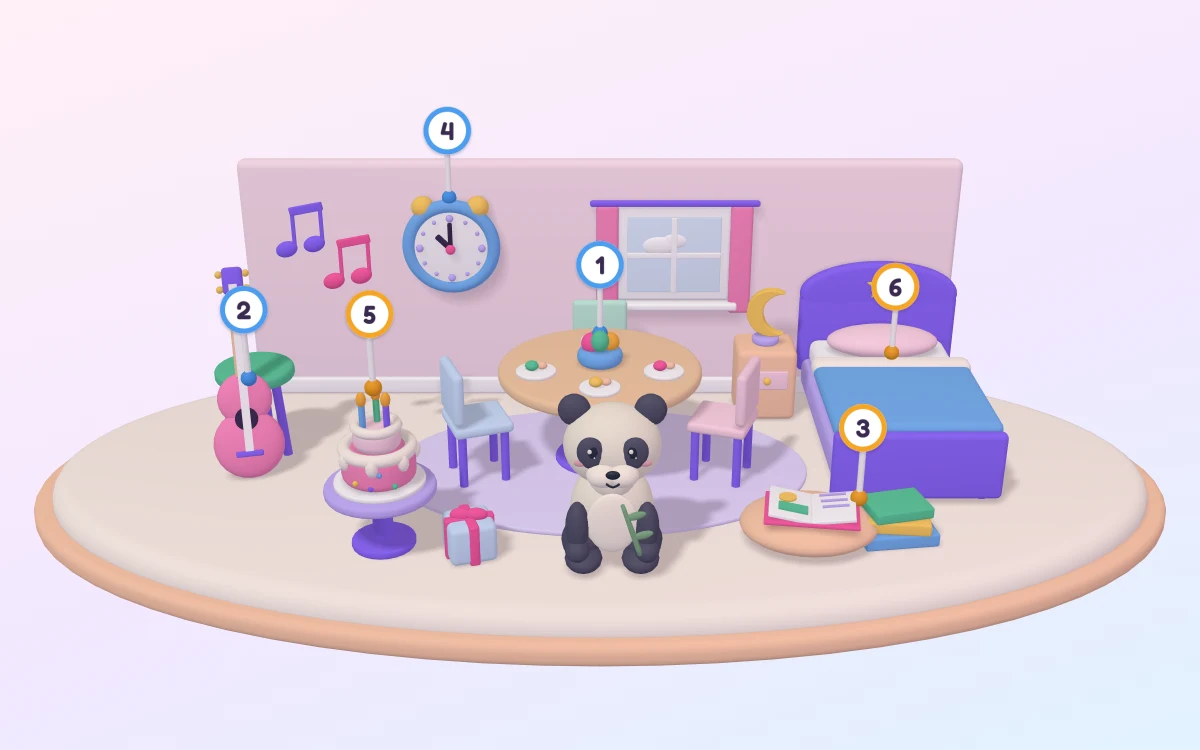
Routines around the house
Each pin marks one finding from family routine research, colored by how strong the evidence is. Almost all of it is correlational: routines and good outcomes go together, which doesn’t show that routines alone cause them.
- Some evidence
- Limited evidence
1. Family dinnersEvidence: Large correlational study (some evidence)
In a nationally representative US sample of about 8,550 preschoolers, family dinner 5 or more days a week went with adjusted odds of 1.4 for high social-emotional health (Muñiz, Silver and Stein, 2014). Parents reported both the routines and the child’s behavior, and the data come from a single wave, so the study can’t say which came first.
2. Stories and songsEvidence: Large correlational study (some evidence)
In the same study, storytelling 3 or more times a week went with adjusted odds of 1.9, and singing 3 or more times a week with 1.5. Reading 3 or more times a week (1.2) was not statistically significant, which doesn’t mean reading is unimportant: it simply wasn’t linked to this one outcome.
3. The same book againEvidence: One lab experiment (limited evidence)
In an experiment by Horst, Parsons and Bryan (2011), 3-year-olds who heard the same stories repeatedly learned and remembered new words. Children who heard different stories, with the same number of exposures to each word, failed to learn them. It was one small lab study, but it hints that asking for the same book again may help young children learn.
4. Predictable, not perfectEvidence: Meta-analysis of correlations (some evidence)
Andrews and colleagues (2021) pooled 35 studies covering 16,480 children. In studies that tested children directly, instability (r = .17) was a stronger correlate of executive function than disorganization (r = .06). Disorganization still counted, but less: days with no predictable shape seemed to matter more than a messy house.
5. Routines vs. ritualsEvidence: Review of 32 publications (limited evidence)
Fiese and colleagues’ 2002 review of 32 publications separated routines, repeated practices that get things done, from rituals, which say something about who the family is, like a birthday tradition. Family routines and rituals were related to parenting competence, child adjustment and marital satisfaction.
6. Bedtime routinesEvidence: Review, outcomes proposed (limited evidence)
Mindell and Williamson (2018) argued that a nightly bedtime routine may support more than sleep, including language, emotional and behavioral regulation and family functioning, and noted that more research on these outcomes is needed. Mindell has consulted for and received grant support from Johnson & Johnson.
Predictability, not perfection: what household chaos studies add
A related line of research looks at the opposite of routine: household chaos, which this meta-analysis defined as disorganization and instability in the home. In a 2021 meta-analysis in Psychological Bulletin, Andrews and colleagues pooled 35 studies covering 16,480 children. More chaos went with weaker executive function, the mental skills behind planning, self-control and switching tasks, with an overall correlation of r = .16, a small effect.
The detail that matters most for parents: in studies that tested children directly, instability (r = .17) was a stronger correlate than disorganization (r = .06). Disorganization still counted, but less: days with no predictable shape seemed to matter more than a messy house. The authors called for more quasi-experimental studies of how disruptions affect executive function. On their own, these correlations can’t show cause, and chaos often travels with stresses such as long work hours or crowded housing that families don’t choose.
The most-studied routine: winding down at night
Bedtime is where routine research is deepest. In a 2018 review in Sleep Medicine Reviews, Jodi Mindell and Ariel Williamson argued that a nightly bedtime routine may support more than sleep, including language, literacy, emotional and behavioral regulation, parent-child attachment and family functioning. They grouped common routine steps into nutrition, hygiene, communication (reading, singing) and physical contact (cuddling, rocking), and noted that more research on the proposed outcomes is needed. Disclosure: Mindell has consulted for and received grant support from Johnson & Johnson Consumer Inc.; the paper states that this review was independent and had no financial support.
For the practical side, see our bedtime routine chart.
Why do kids (and toddlers) like routine?
No single study answers this, but several findings fit together:
- Predictability lets kids get ahead of the day. Spagnola and Fiese describe routines as giving the day a predictable shape that steers what everyone does next. When a child knows that shoes come after breakfast, there is less to negotiate and less to be surprised by.
- Repetition helps young children learn. In an experiment by Horst, Parsons and Bryan (2011), 3-year-olds heard storybooks that introduced made-up words over one week. Children who heard the same stories repeatedly learned and remembered the new words. Children who heard different stories, with the same number of exposures to each word, failed to learn them. It was one small lab study, but it suggests that asking for the same book again may be part of how young children learn.
- Kids shape routines too. Spagnola and Fiese use a transactional model: a child’s temperament and a parent’s habits affect each other over time. An easygoing child may make routines easier to keep, which is one reason the correlations above can’t be read as one-way effects.
- “In our family we…” may carry weight. In two experiments, Sabine Doebel and Yuko Munakata (2018) found that 3- to 5-year-olds waited longer on the marshmallow task when told their own group waited and another group didn’t, than children told the reverse. That is a lab result about self-control, not about families, but it hints that framing a routine as part of who your family is could help. Our marshmallow test review covers what else shapes kids’ waiting.
What the research can’t tell you
- That routines cause the outcomes. Almost all of this evidence is correlational. Families with more routines may also differ in other ways, such as work schedules, support or a child’s temperament, that affect the same outcomes. Fiese’s 2002 review named these design limits, and the 2021 meta-analysis called for stronger designs.
- Which routine matters most, or how many you need. Studies measured different routines in different ways, and none sets a minimum number.
- That stricter is better. The American Academy of Pediatrics’ HealthyChildren.org advice describes routines as a middle ground: enough order to avoid confusion, but not so strict that kids never get a say.
- What works for specific needs. Families of children with autism or a trauma history often have more specific questions, and those deserve guidance from your child’s care team, not general family research.
This article is general information about family research, not medical advice. If you’re concerned about your child’s behavior, sleep, anxiety or development, talk with your pediatrician.
How to turn a routine into a family ritual
Start with the routine that causes the most friction, often mornings. Our morning routine guide and after-school routine checklist cover the steps. If the week has fallen apart after a trip or a busy season, a family routine reset gets things moving again. Then add a little meaning:
Try this at home
- Pick one anchor moment. Choose a time most of the family shares, such as dinner, the drive to school or the last ten minutes before lights-out, and keep its order the same on ordinary days.
- Add one small piece of meaning. A question at dinner, a made-up story in the car or a goodnight phrase. Example script (illustrative): “Rose, thorn, bud: one good thing, one hard thing, one thing you’re looking forward to.”
- Name it as yours. Example script (illustrative): “In our family, we tell one story at dinner.” Group identity is part of what makes a ritual a ritual.
- Let kids add to it. Ask your child to choose the song, the story topic or the Saturday breakfast. Giving kids a real say is a simple way to make a ritual feel like theirs too.
- Plan a lighter version for hard days. Decide in advance what the five-minute version looks like on a sick day or a late night, so the ritual bends instead of breaking.
- Give it time. New routines often take weeks, sometimes longer, to feel automatic, and most of that research is in adults. See how long it takes a child to form a habit.
More guides for each part of the day are in our kids’ routines hub.
Keep the routine visible, keep the ritual yours
Star Chart Kids is one optional tool for the routine half of this. Families can group tasks into Morning, After-School and Bedtime quests, or make their own, set tasks to repeat on chosen weekdays, and start fresh each day with a daily reset and no streaks. The ritual half, the stories, songs and togetherness, is up to your family; no app supplies that. It’s free for kids roughly 3–12, with no ads or leaderboards. A parent creates a username and parent passcode; no email or payment required.
Frequently asked questions
Why are routines important for young children?
Reviews of family research link regular routines, such as shared meals, storytelling and bedtime, with better social-emotional skills, self-regulation, language and school readiness in young children. Most of these studies are correlational, so routines are best seen as one supportive part of family life rather than a proven cause of those outcomes.
Why do toddlers like routine so much?
A predictable day lets toddlers anticipate what comes next, and repetition helps them learn. In one experiment, 3-year-olds who heard the same storybook several times learned and remembered new words, while those who heard different stories failed to learn them. It was a single small study, but it suggests asking for the same book again can help young children learn.
What is the difference between a routine and a ritual?
Family researchers describe routines as observable, repeated practices that get things done, like brushing teeth after breakfast. Rituals carry symbolic meaning about who the family is, like a birthday breakfast tradition or a special goodnight phrase. The same activity can be either one, depending on the meaning the family gives it.
Can too much routine be bad for kids?
It can. An American Academy of Pediatrics article on HealthyChildren.org describes the goal as a balance between the confusion of no routines and the boredom of a structure so rigid that children get no choice or flexibility. A routine that bends on sick days, holidays and hard days is easier to keep than one that has to be perfect.
How many family routines does a child need?
There is no research-based number. In a nationally representative US study of about 8,550 preschoolers, each additional routine a child took part in, such as family dinners, storytelling, singing or play, went with higher odds of strong social-emotional health. Starting with one or two that fit your week is a reasonable goal.
Sources and further reading
- A review of 50 years of research on naturally occurring family routines and rituals: Cause for celebration? (Journal of Family Psychology (Fiese, Tomcho, Douglas, Josephs, Poltrock & Baker, 2002))
- Family Routines and Rituals: A Context for Development in the Lives of Young Children (Infants & Young Children (Spagnola & Fiese, 2007))
- Family Routines and Social-Emotional School Readiness Among Preschool-Age Children (Journal of Developmental & Behavioral Pediatrics (Muñiz, Silver & Stein, 2014))
- Routines and child development: A systematic review (Journal of Family Theory & Review (Selman & Dilworth-Bart, 2023))
- Examining the effects of household chaos on child executive functions: A meta-analysis (Psychological Bulletin (Andrews, Atkinson, Harris & Gonzalez, 2021))
- Benefits of a bedtime routine in young children: Sleep, development, and beyond (Sleep Medicine Reviews (Mindell & Williamson, 2018))
- Get the Story Straight: Contextual Repetition Promotes Word Learning from Storybooks (Frontiers in Psychology (Horst, Parsons & Bryan, 2011))
- Group Influences on Engaging Self-Control: Children Delay Gratification and Value It More When Their In-Group Delays and Their Out-Group Doesn’t (Psychological Science (Doebel & Munakata, 2018))
- The Importance of Family Routines (HealthyChildren.org, American Academy of Pediatrics (Flais))