
← Explore the Rewards & Motivation topic hub
Quick answer: print the sticker reward chart when a young child is working toward one goal, the blank reward chart to practice a specific behavior each day, or the 20-star goal chart when you want a clear path to the finish line. All four charts below are free PDFs in US Letter and A4, with no email required, and print clearly in black and white.
Free reward chart templates to print
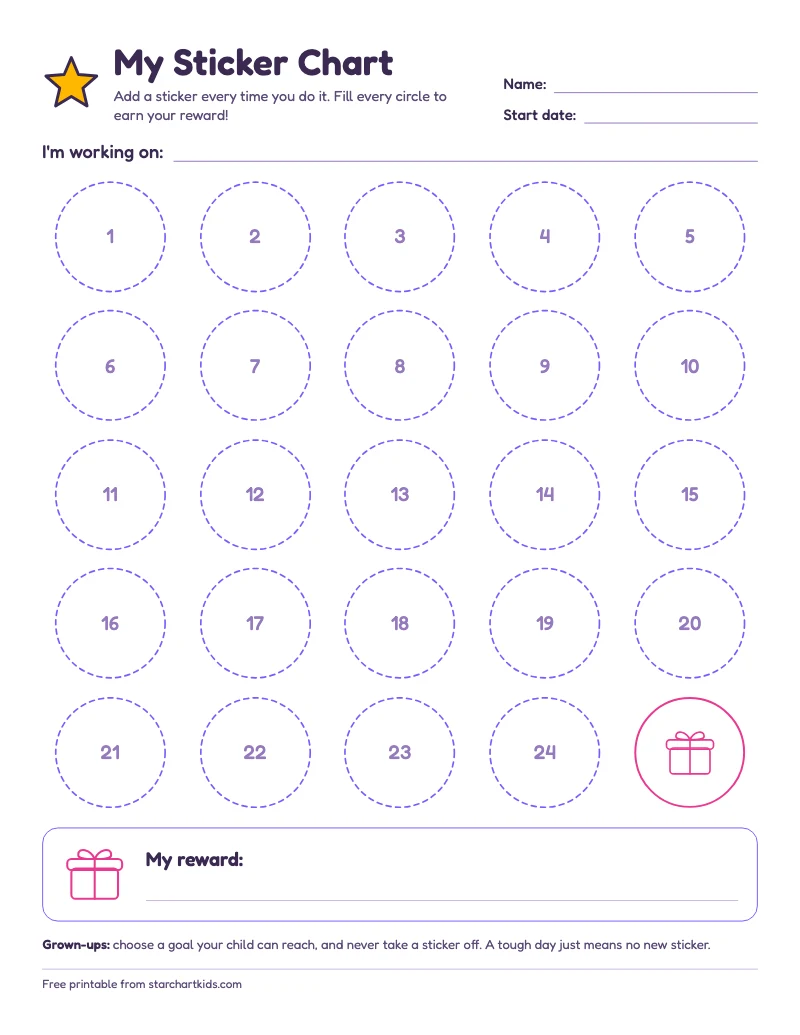
Sticker reward chart
Ages 2–8. Twenty-four sticker circles lead to a reward circle, with a goal line and a “My reward” box.
Download sticker reward chart, US Letter PDFDownload sticker reward chart, A4 PDF
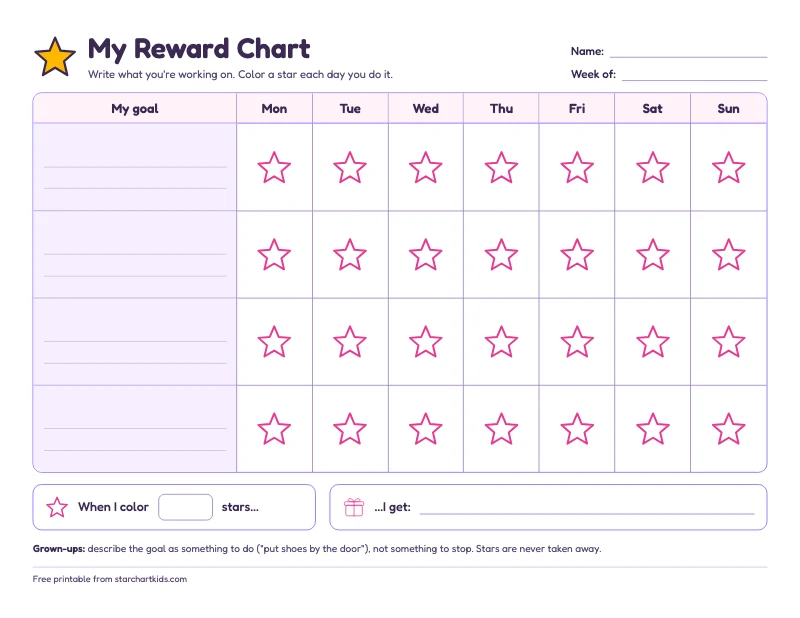
Blank reward chart
Ages 3–10. Write up to four goals or behaviors and color a star each day you practice them.
Download blank reward chart, US Letter PDFDownload blank reward chart, A4 PDF
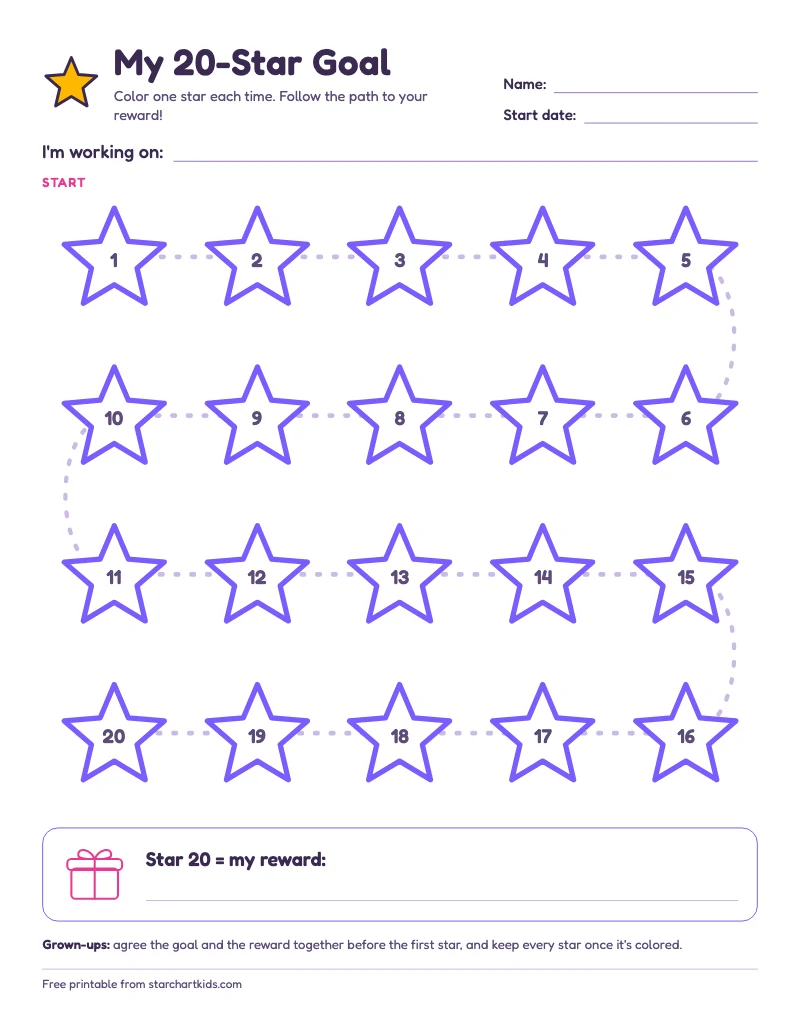
20-star goal chart
Ages 3–9. A path of twenty numbered stars that ends at the reward your child chose.
Download 20-star goal chart, US Letter PDFDownload 20-star goal chart, A4 PDF
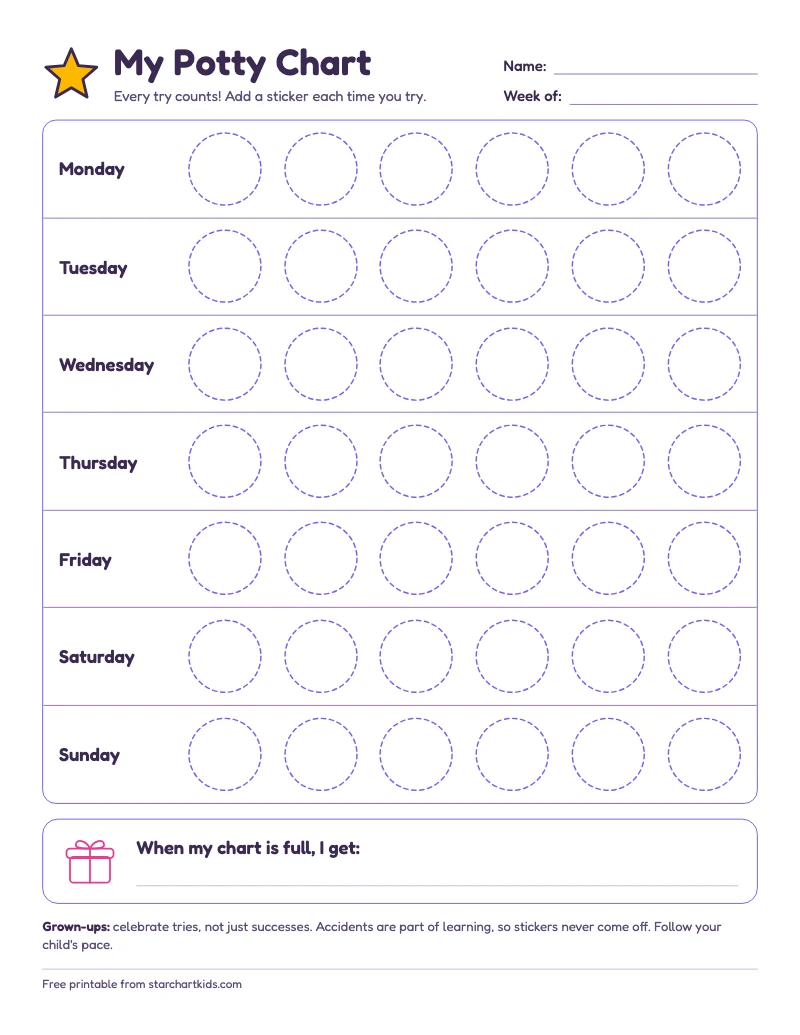
Potty reward chart
Toddlers learning to use the potty. A sticker for every try, seven days on one page.
Download potty reward chart, US Letter PDFDownload potty reward chart, A4 PDF
Need a chart for daily jobs instead? See the free printable chore charts: weekly, daily, toddler, teen, family and blank.
Which reward chart should you print?
| Chart | Best for | How it works |
|---|---|---|
| Sticker reward chart | Ages 2–8, one clear goal | One sticker per success; fill all 24 circles to reach the reward |
| Blank reward chart | A behavior you practice daily, such as getting dressed without reminders | Write up to four goals; color a star each day it happens |
| 20-star goal chart | Ages 3–9 who like seeing the finish line | Color the numbered stars in order along the path to the reward |
| Potty reward chart | Toddlers learning to use the potty | A sticker for every try, seven days on one page |
How to use a printable reward chart well
- Pick one goal and say it positively. “Shoes by the door after school” gives a child something to do; “no mess” only says what to stop.
- Agree the reward before you start and write it on the chart, so nobody is negotiating halfway through.
- Make the first reward reachable. A child who earns something in the first few days learns that the chart is real. Lengthen the path later.
- Mark it straight away. Let your child add the sticker or color the star the moment it happens, with a specific word of praise.
- Never take a mark away. Missed days stay empty. The chart only ever records progress.
- Retire it when the habit sticks. Celebrate, then move on to a new goal or no chart at all.
For the full method, including what to do when a chart stops working, read our reward chart guide for kids. If you're wondering whether rewards backfire, do reward charts work? looks at the research.
Choosing rewards that keep working
The best rewards are small, specific and easy for you to deliver soon. A reward that takes weeks to arrive, or that you might not be able to give, weakens the whole chart. Mix in rewards that cost nothing:
- Time together: a board game, a walk to the park, baking cookies.
- Choices: picking dinner, the bedtime story or the weekend film.
- Privileges: staying up 15 minutes later on Friday, sitting in the “big” chair.
Our non-toy reward ideas include a printable reward menu you can build with your child.
Using a potty reward chart gently
A potty chart should celebrate trying, not only success. Give a sticker for each time your child sits on the potty, keep the chart somewhere they can reach, and treat accidents as part of learning: no stickers come off and no one is scolded. If the chart starts to cause stress, put it away for a while. Questions about readiness or setbacks are best taken to your child's doctor.
Printable reward chart or reward chart app?
A printed chart is perfect for one goal and one child. When you are tracking several children, chores that change by day, or rewards kids save up for, an app can do the counting for you. Star Chart, our free app, works like a digital star chart: kids tap a finished task, earn stars, and spend them on rewards you approve. It has no ads or subscription and needs only a username and a parent passcode.
Frequently asked questions
Are these reward charts free to print?
Yes. Every chart is a direct PDF download in US Letter and A4, with no email signup and no watermark. Print as many as you need.
How many stickers or stars should a reward chart have?
Start short. A young child may need a reward after five to ten marks, so cover part of the sticker chart or fill some circles in advance. If interest fades before the end, the path is too long for now.
Should I take stars away for bad behavior?
No. Once a star or sticker is earned, it stays. A difficult moment just means no new star. Taking marks away turns the chart into a punishment tool and makes children stop trusting it.
What reward should I write on the chart?
Something small, specific and easy to deliver soon, agreed with your child before the chart starts: choosing a weekend breakfast, an extra bedtime story, or a trip to the park. Experiences and time together work as well as toys.
Should I print the US Letter or the A4 version?
Choose US Letter in the US and Canada, and A4 in the UK, Ireland, Europe, Australia, New Zealand and most other countries. If you print the other size, choose “Fit to page” in your print settings.
When should we stop using a reward chart?
When the behavior happens most days without the chart. Say so out loud, celebrate it, and either retire the chart or swap in a new goal. Many families phase rewards out gradually rather than all at once.
Sources and further reading
- What's the Best Way to Discipline My Child? (HealthyChildren.org, American Academy of Pediatrics)